LEAKPROOF pressure leaf filtration

LEAKPROOF Vertical Pressure Leaf Filter

A vertical pressure leaf filter is a closed batch filter for removing fine solids from a liquid: a vertical pressure vessel with a set of stainless steel wire-mesh filter leaves inside. The slurry is pumped in under pressure, the filtrate passes through the leaves into a common outlet manifold, and the solids stay on the leaves as a cake that is dried and dropped through the bottom valve. Peltech builds the LEAKPROOF range in Malaysia, in eighteen standard sizes from 10 to 125 m² of filter area, mainly for bleaching earth and catalyst filtration in edible oil refineries, oleochemical plants and biodiesel and renewable diesel plants, and supports every unit with filter leaves, spares and re-meshing from Malaysia, Singapore and Indonesia.

Stainless steel LEAKPROOF vertical pressure leaf filter: swing-bolt top cover with davit arm, vent nozzle and side support lugs
A stainless steel LEAKPROOF vertical pressure leaf filter in our works in Malaysia: swing-bolt top cover with davit arm, vent nozzle and the side support lugs that carry the vessel on its structure.
10–125 m²filter area, 18 standard models
ASME VIII Div. 1vessel design, DOSH (JKKP) registered works
Dry or wetcake discharge: vibrator or sluice
5-ply SS316Lfilter leaves, riveted frames
Inside the filter

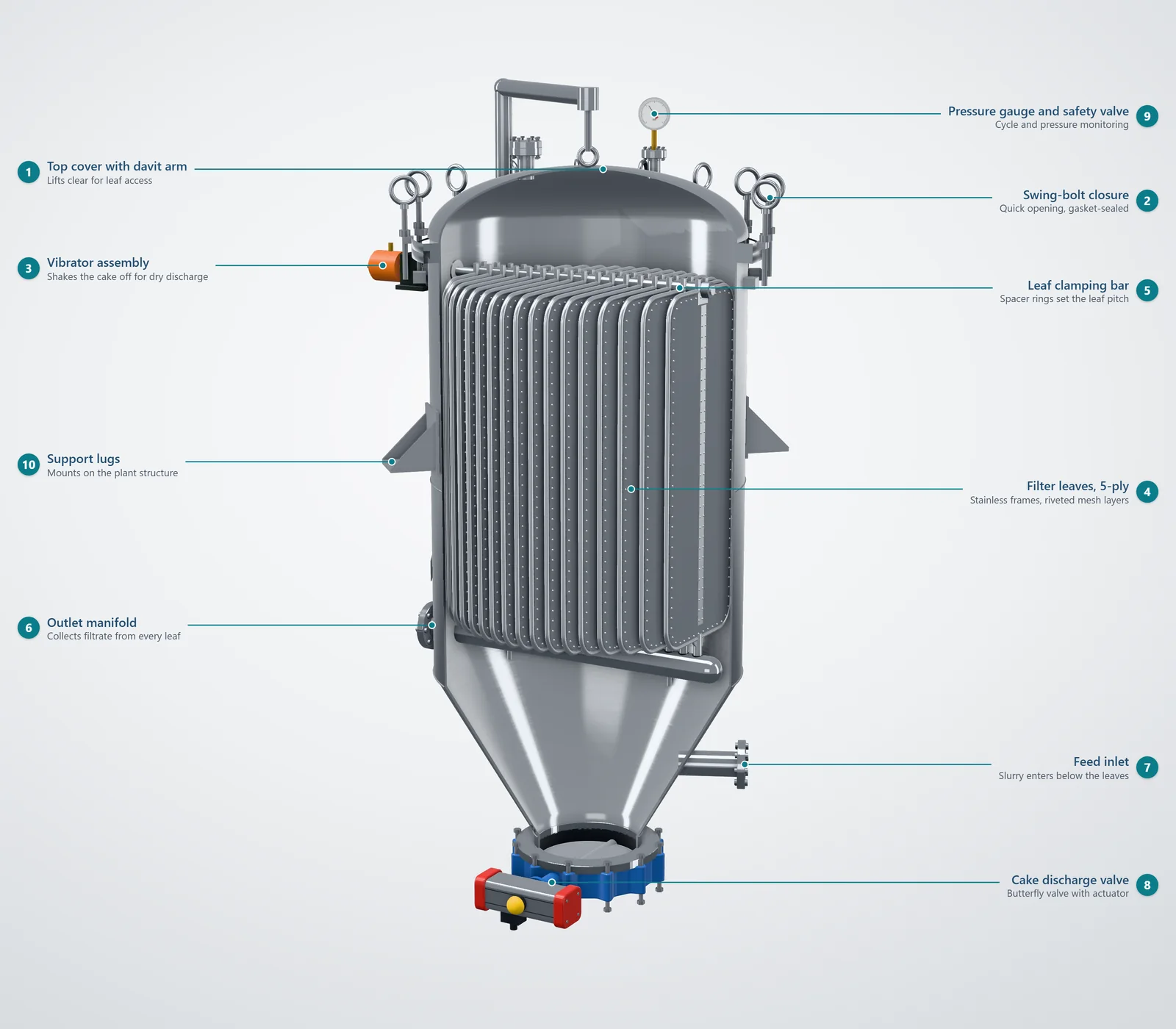
What Is Inside a LEAKPROOF Leaf Filter

Labelled cut-away render of a Peltech LEAKPROOF vertical pressure leaf filter showing top cover, davit, vibrator, filter leaves, outlet manifold and cake discharge valve
Drag to turn · double-click a part, + or Ctrl + scroll to zoom · right-drag to move
Model of a 60 m² unit (17 leaves): drag to turn it; the numbers match the list. Proportions follow our general arrangement drawing, not a certified drawing; the parts shown are the same on every size.
1

Top Cover with Davit Arm

The dished top cover lifts clear on a davit arm, with a hydraulic hand pump on the larger sizes, so the whole leaf set can be lifted out for inspection, cleaning or leaf exchange.

2

Swing-Bolt Closure

Swing bolts with hand wheels clamp the cover on an EPDM cord gasket laid in a groove in the shell flange. The wheels are tightened by hand only, in two or three rounds, until metal contact is made.

3

Vibrator Assembly

A pneumatic piston vibrator mounted outside the vessel on a sealed shaft shakes the leaf set through the clamping bar to drop the dried cake. It runs on clean, lubricated air at 6 bar; one to two minutes of vibration clears a well-dried cake.

4

Filter Leaves, 5-Ply

Rectangular leaves of five layers of SS316L wire mesh (two filter plies over support and drainage mesh) bound in a 1.6 mm capping channel and riveted at 40 mm pitch. The largest leaves sit at the centre of the vessel, the smallest at the two ends.

5

Leaf Clamping Bar

A bar across the top of the leaf set, with spacer rings that fix the leaf pitch, ties every leaf to the vibrator. Its lock nuts are checked for tightness once a week.

6

Outlet Manifold

A flanged stainless steel pipe along the bottom of the leaf set with one socket per leaf. Each leaf nozzle seats in the manifold on an O-ring, and the manifold is levelled so that every leaf hangs at the same height.

7

Feed Inlet

The slurry enters below the leaves. While filling, the vent at the top stays open until liquid shows at the vent.

8

Cake Discharge Valve

A butterfly valve with a replaceable rubber liner closes the bottom cone. It is opened by a double-acting pneumatic actuator with solenoid valve and limit switch; a manual swing-type cake door is the simple, economical alternative.

9

Pressure Gauge and Safety Valve

The top of the vessel carries the pressure gauge, the safety valve and the vent. A pressure transmitter and high and low level switches can be added for automatic sequencing.

10

Support Lugs

Lugs, legs or a skirt carry the filter on the plant structure. The vessel is levelled and bolted down through the lug holes.

Also labelled in the model: 11 Davit Arm, 12 Handwheel Lifting Screw, 13 Vent / Safety Valve Nozzle, 14 Body Flange and Gasket, 15 Filtrate Outlet, 16 Conical Bottom, 17 Nameplate.
How it works

The Filtration Cycle in Eight Steps

A LEAKPROOF filter works in batches. It filters until the space between the leaves is full of cake, or until the cake resists the flow too much, and then stops to discharge it. A plant therefore usually runs two filters: one filters while the other is emptied. The diagram and the eight steps below show the principle for bleached oil with dry cake discharge; times, pressures and steam or air use are set for each duty when we size the filter.

Step 1 of 8: FillThe pump fills the filter with unfiltered oil; the vent lets the air out.
Feed Tankoil from the bleacher Precoat Pump Leaf Filter vibrator pressure vent back to the feed tank SteamAir Filtrateto the next stage to the standby filter cake bin Feed Tank Precoat Pump Filter SteamAir Filtrate To Filter 2
Unfiltered oilFirst pass, back to the feed tankFiltered oilAirSteamCake
1

Fill

The filter pump fills the vessel with unfiltered oil from the feed tank while the vent lets the air out. The filtrate outlet stays closed.

2

Circulate Until Clear

The oil leaving the leaves is sent back to the feed tank while a first thin layer of solids builds up on the mesh. Once that layer is in place the filtrate runs clear. Where the solids are too fine, a precoat of filter aid is laid on the leaves first.

3

Filter

Clear oil now goes forward to the next stage. The cake grows on both faces of every leaf and the pressure slowly rises; the run ends when the cake space is full or the pressure reaches its set limit.

4

Empty the Heel

The feed stops. Gentle air pressure pushes the unfiltered oil left in the vessel over to the standby filter, keeping a flow through the cake so that it stays on the leaves.

5

Depressurise

The vessel is vented to release the pressure.

6

Dry the Cake

Steam, air or an inert gas is blown through the cake to push out the oil it still holds. This recovers product and leaves a dry, crumbly cake.

7

Open and Discharge the Cake

The discharge valve in the bottom cone is opened and the pneumatic vibrator shakes the leaf set: the dry cake drops off the leaves, through the cone, into a bin or conveyor.

8

Close and Stand By

The valve closes and the filter is ready for the next fill. The cover stays closed; it is only lifted for inspection or leaf changes.

Wet cake discharge. Where the solids can be handled as a slurry, or must not be dried, the filter is fitted instead with an oscillating sluice pipe above the leaves. After the heel is emptied, sluicing liquid washes the cake off the leaves and out through the bottom valve as a concentrated slurry. The vessel, leaves and manifold are the same; only the discharge equipment differs.
Precoat and body feed. A leaf filter is not a strainer: once a first cake has formed, the cake does the filtering. Slurries with too few or too fine solids to bridge the mesh, or sticky solids that would blind the cloth, are filtered through a precoat of filter aid, and a body feed of filter aid during the cycle keeps compressible cakes open and the cycle long. Very thick slurries are better handled in another type of filter.
Design and construction

Built to ASME VIII Div. 1 in Malaysia

Pressure Vessel

Designed and built to ASME VIII Div. 1 at our works in Malaysia, which is registered with DOSH (JKKP) as a manufacturer and repairer of pressure vessels. The standard sheet is 6 bar at 150 °C design (4.5 bar at 130 °C working), hydrotested at 1.3 times the design pressure; other ratings on request. Dished top cover, cylindrical shell, conical bottom.

Materials

Shell, cover and flanges in carbon steel SA 516 Gr 70, blast-cleaned to Sa 2.5 and painted, or in stainless steel SS304 or SS316L. Nozzles in seamless pipe with PN 16 slip-on flanges; ANSI flanges on request. Filter leaves in SS316L, with SS904L mesh as an option for more corrosive duties.

Filter Leaves

Five plies of wire mesh: one drainage ply (plain weave 4 × 4, 1.6 mm wire), two support plies (plain weave 8 × 8, 0.7 mm wire) and two filter plies (plain weave 60 × 60, plain Dutch 24 × 110 or reverse Dutch PZ 80), all in a 1.6 mm SS316L capping channel with 150 mm corner radii and 4 mm rivets at 40 mm pitch. Leaf height 920 to 1,810 mm by model.

Outlet Manifold and Leaf Seals

Flanged SS316L manifold with one O-ring socket per leaf, bolted to the shell and levelled at installation. Leaf O-rings and the cover gasket are the only parts that need regular replacement.

Cover and Closure

Swing bolts and hand wheels on an EPDM cord gasket. Davit arm with hydraulic hand pump for lifting the cover and the leaf set; the leaves are numbered and lifted out one by one.

Cake Discharge

Butterfly valve in the bottom cone with a replaceable rubber liner, double-acting pneumatic actuator, solenoid valve and limit switch (about 8.5 litres of air at 6 bar per stroke). Manual swing-type cake door as the economical option. Oscillating sluice pipe for wet discharge.

Vibrator

Pneumatic piston vibrator (VTL 555 type, 2,640 N, up to 2,400 vibrations per minute, 755 L/min of air at the maximum) on a sealed shaft, fed through a filter-regulator-lubricator. Working pressure 6 bar; the clamping bar transmits the vibration to every leaf.

Instruments and Options

Pressure gauge, safety valve and vent as standard. Pressure transmitter, high and low level switches, heating jacket for hot filtration, filtrate sight glass, control panel for automatic sequencing, and a skid with feed pump, buffer tank and piping on request.

Documentation

Each filter is delivered with its manufacturing data report, material certificates including the mill certificate of the wire mesh, general arrangement drawings and the installation, operation and maintenance manual.

Applications

What Pressure Leaf Filters Are Used For

A pressure leaf filter suits any process liquid that carries fine solids which build up into a filter cake: spent adsorbents, catalysts, waxes, precipitates or filter aid. Plants choose it when they want a closed filter with no operator contact, a dry cake that leaves the vessel without opening the cover, little product lost with the cake, and one set of leaves running for years. These are the usual duties.

Bleaching Earth Filtration

Edible oil refining

The main duty in palm oil and edible oil refineries. Spent bleaching earth (1 to 2% of the oil) is filtered out of bleached palm, palm kernel, coconut, soybean and other oils after the bleacher, and the cake is steam-blown so that it leaves the filter with as little oil as possible. Two filters alternate, and a polishing bag or cartridge filter follows as the safety filter before the deodoriser.

Hydrogenation Catalyst

Oils, fats and fatty acids

After hydrogenation the spent nickel catalyst is filtered out of the hardened oil, fat or fatty acid, usually with a little filter aid. The closed vessel keeps the catalyst away from operators and air, and the cake is discharged dry or as a slurry for reclaiming. A second filtration with bleaching earth (post-bleach) often follows to take out the last traces of nickel and soap.

Winterization and Dewaxing

Sunflower, rice bran, corn and canola oil

Oils that turn cloudy in the cold are chilled so that waxes and high-melting glycerides crystallise, and the crystals are filtered out at low temperature. The filter runs on a precoat and a body feed of filter aid, with the leaf mesh and the cake space chosen for a slow-filtering, compressible wax cake.

Crude and Pressed Oil Clarification

Crushing plants and mills

Expeller-pressed palm kernel and coconut oil, and crude oils from other seeds, carry meal fines and foots. A leaf filter clarifies the oil before storage, sale or refining, and the fines leave the filter as a dry cake.

Activated Carbon and Adsorbents

Colour, PAH and trace contaminants

Powdered activated carbon, often mixed with bleaching earth, is dosed to remove polycyclic aromatic hydrocarbons (PAH) from coconut and fish oil, to take colour out of glycerine and other liquids, and to adsorb trace contaminants. Carbon is very fine, so it is filtered on a precoat, with a fine Dutch-weave filter ply where needed.

Oleochemicals

Fatty acids, fatty alcohols, esters, glycerine

Bleaching earth and filter-aid filtration of fatty acids and methyl esters, catalyst removal after fatty acid and fatty alcohol hydrogenation, and carbon treatment of glycerine. SS316L leaves are standard; SS904L mesh is offered where the acid number or the temperature calls for it.

Biodiesel and Renewable Diesel

Feedstock pretreatment

Before transesterification or hydrotreating, crude and degummed oils, animal fats and used cooking oil are bleached to take out phosphorus, metals, chlorophyll and soap, which would foul the catalyst downstream. The leaf filter removes the spent adsorbent. In biodiesel plants it also removes the magnesium silicate or other adsorbents used to dry-wash the methyl ester.

Chemicals and Lubricant Additives

Precoat and catalyst filtration

Clarification of resins, lubricant additives, solvents and other process liquids, recovery of catalysts, and removal of precipitated salts. Where the solids are too fine or too sticky to bridge the mesh, the filter runs on a precoat and body feed of filter aid with fine Dutch-weave leaves.

Other Duties

Ask us with a sample

Pressure leaf filters are also used for molten sulphur (with a heating jacket), brine for chlor-alkali plants, and sugar and glucose syrups after carbon treatment. Send the liquid, its temperature and flow, and a solids analysis, and we will tell you whether a LEAKPROOF filter is the right tool.

Where It Sits in an Edible Oil Refinery

Crude oil
degummed first (or neutralised, in chemical refining)
Bleacher
bleaching earth takes up colour, gums and traces of metal
LEAKPROOF leaf filter
holds back the spent earth; clear oil goes on
Polishing filter
a bag or cartridge filter catches any fines that slip through
Deodoriser
steam removes smell and free fatty acids: refined oil

Fitted with suitable leaves and settings, the same filter also removes the nickel catalyst after hydrogenation, takes out wax in winterization, and cleans the feed for biodiesel and renewable diesel plants. In a refinery a LEAKPROOF polishing bag or cartridge filter follows the leaf filter as the safety filter.

When a Leaf Filter Is the Right Choice

  • Fine solids that build up into a cake on the leaves, from a trace to a moderate amount; filter aid helps where the solids are too fine or too few.
  • Large, steady flows: two filters take turns, so the plant never stops filtering.
  • Jobs where the solids must come out as a dry cake, with little liquid lost and without opening the filter.
  • Hot, flammable or hazardous liquids that must stay inside a closed vessel.
  • Low running cost: the stainless steel leaves are used again cycle after cycle for years, with no filter cloths or cartridges to throw away.

When Another Filter Is Better

  • Only a trace of solids: a bag or cartridge filter is cheaper and needs no cake.
  • Very thick slurries with a high share of solids: a filter press or a centrifuge.
  • Separating palm olein from stearin (dry fractionation): membrane filter presses are the usual choice.
  • Coarse particles such as sand, scale or fibres: a strainer or a vibrating screen.
Our delivery records include LEAKPROOF filters, filter leaves, re-meshing and spares for more than sixty edible oil refineries and oleochemical plants in Malaysia, Singapore and Indonesia, as well as palm oil mills, a renewable fuel plant, and chemical and lubricant-additive plants.
Models and specifications

Eighteen Standard Sizes, 10 to 125 m²

Model code: P30V-1225-1250-15 is a 30 m² vertical filter with a 1,225 mm tank diameter, 1,250 mm leaf height and 15 leaves. Tank height is the vessel from the bottom flange to the top of the cover, without legs or davit. Larger areas and other vessel ratings are built to order.

ModelFilter area (m²)Tank diameter (mm)Tank height (mm)Leaf height (mm)No. of leaves
P10V-900-920-91090019009209
P15V-1100-1250-9151100230012509
P20V-1100-1250-112011002300125011
P25V-1225-1250-112512252400125011
P27V-1225-1250-132712252400125013
P30V-1225-1250-153012252400125015
P30.5V-1380-1350-1130.513802650135011
P35V-1380-1350-133513802650135013
P38V-1380-1350-153813802650135015
P42V-1500-1500-134215002900150013
P46V-1500-1500-154615002900150015
P50V-1500-1500-175015002900150017
P60V-1500-1650-176015003050165017
P70V-1650-1810-167016503340181016
P78V-1650-1810-187816503340181018
P85V-1850-1810-188518503470181018
P100V-1850-1810-2010018503470181020
P125V-2000-1810-2412520003500181024

Nozzle sizes, operating weight, headroom for lifting the leaves and floor space are given in the general arrangement drawing quoted for each model.

Parts and spares

Leaves, Spares and Re-meshing from Malaysia

Every LEAKPROOF filter is supported from Malaysia with the parts that wear: leaves, gaskets, O-rings, valve liners and vibrator parts, for our own filters and for other makes of vertical pressure leaf filter.

Set of stainless filter leaves for a Peltech vertical pressure leaf filter, outlet nozzles aligned

Filter Leaf Set

Complete numbered set of 5-ply leaves in SS316L, made to the manifold pitch of your filter, for LEAKPROOF and other makes.

Peltech filter leaf with riveted stainless frame, fine filter cloth and exposed drainage mesh

Filter Leaf Construction

Riveted SS316L capping channel, fine filter cloth on the outside, support and drainage mesh inside, outlet nozzle at the bottom.

Pneumatic piston vibrator assembly with housing and shaft

Vibrator Assembly

Pneumatic piston vibrator with sealed shaft housing and clamping-bar fork; strip and clean every six months, oil level weekly.

Lug butterfly valve with pneumatic actuator

Butterfly Valve with Actuator

Cake discharge valve with double-acting pneumatic actuator, solenoid valve and limit switch; seat checked every two months.

Rubber butterfly valve liner with stem holes

Valve Liner

Replaceable rubber liner for the cake discharge valve; the usual spare after the gasket and O-rings.

Stainless outlet manifold with flange and outlet ports

Outlet Manifold

Flanged SS316L manifold with one O-ring socket per leaf; supplied with a new set of leaf O-rings.

Coil of rubber cord gasket for the filter top cover

Top Cover Gasket

EPDM cord gasket cut to 3.14 × tank diameter plus 15 mm, joined at 45° and pressed into the flange groove; inspected at every opening.

FAQ

Frequently Asked Questions

What is a pressure leaf filter used for?

For filtering fine solids out of large volumes of liquid in a closed vessel, where the solids build a cake that can be dried and discharged without opening the filter. The main uses are bleaching earth filtration in edible oil refining, nickel catalyst filtration after hydrogenation, winterization and dewaxing of oils, activated carbon treatment, and the pretreatment of feedstock for biodiesel and renewable diesel. Oleochemical, chemical and lubricant-additive plants use leaf filters for adsorbent, catalyst and precoat filtration.

How do I size a pressure leaf filter for my refinery?

By the solids load per cycle. Throughput in tonnes per day, bleaching earth dosage in percent and the cycle time you want give the mass of cake per cycle; divided by the cake bulk density it gives the cake volume the filter must hold, and that fixes the filter area and leaf spacing. Send us the throughput, dosage and oil type and we will size it.

How much cake can a leaf filter hold, and what ends the cycle?

The cake space between the leaves is fixed by the leaf spacing, and the cycle ends when that space is full or when the pressure drop across the cake reaches its set limit, whichever comes first. The leaves must never be overfilled until the cakes touch: that bends the leaves and shortens every later cycle. Very thick slurries are not suited to a leaf filter.

How long does one filtration cycle take?

Most of the cycle is filtration, usually some hours; emptying the heel, drying and discharging the cake take only a short time after that. With two filters alternating, the plant filters continuously.

Dry or wet cake discharge: which should I choose?

Dry discharge, with steam or air drying and a pneumatic vibrator, is the choice for bleaching earth and catalyst: the cake comes out dry and friable, and the steam blow recovers oil that would otherwise leave with the spent earth. Wet discharge, with an oscillating sluice pipe, suits solids that can be handled as a slurry or must not be dried. The vessel and leaves are the same.

How often should the leaves be re-meshed, and how many times?

Check the leaves at every leaf change by holding them up to the light: blinding, thin spots in the cake, loose binding or bent frames mean they need cleaning or re-meshing. Cleaned regularly and handled with care, a set lasts for years. Each leaf can be re-meshed up to four times on its own frame, which saves 30 to 50% against a new leaf, depending on the material and design. We re-mesh leaves of any make in Malaysia.

What materials are the filter and the leaves made of?

The vessel is carbon steel SA 516 Gr 70 or stainless steel SS304 / SS316L, designed to ASME VIII Div. 1. Standard leaves are SS316L frame and mesh, which is suitable for palm oil refining; SS904L mesh is offered for more corrosive duties. The cover gasket is EPDM and the leaf seals are O-rings.

Which spares should a refinery keep in stock?

A cover gasket, a set of leaf O-rings, a valve liner and the vibrator wear parts cover a year of normal operation. Plants that cannot stop for re-meshing keep a spare set of leaves and send the used set to us while the spare set runs.

Can Peltech supply leaves or parts for a filter of another make?

Yes. We build vertical and horizontal leaves to sample or drawing for any make, and we supply gaskets, O-rings, liners and vibrator parts for other vertical leaf filters. Send the leaf size, frame profile, nozzle type, number of leaves and photos of both faces and the nameplate.

Need a Quote or a Sizing Check?

Send us your duty, a drawing or a photo of your existing unit. A Peltech engineer will reply with options and a quotation.