

Body and Code
Fabricated bodies designed to ASME B31.1 and/or ASME VIII Div. 1, 150 psig at 150 °F (10.3 barg at 65.6 °C) for the standard range, and pressure tested before dispatch. Higher pressures and temperatures are designed to order.


A basket strainer keeps solids out of the pumps, meters, valves and heat exchangers downstream: weld slag, scale, stones, fibres or anything else the pipeline carries. The liquid flows into a removable basket and out through its perforated wall, so the debris stays in the basket until it is lifted out and emptied. LEAKPROOF simplex basket strainers are fabricated in Malaysia in carbon or stainless steel, with a basket that seats on a machined seat so nothing flows around it, for water, oil, process liquids and gas.
A flat cover on studs and nuts, with a lifting lug. Quick-opening covers with hinged eye bolts are available for baskets that are cleaned often.
Flanged to ANSI B16.5, in line with the outlet, so the strainer fits straight into the pipe run. Butt-weld ends on request.
A gasket or O-ring in EPDM or Viton seals the cover on the body flange.
A perforated stainless steel basket, 3 mm holes as standard, with a slanted top that faces the inlet. It holds the debris and comes out by its handle.
A woven mesh inside the perforated basket, from 20 to 200 mesh, for a finer cut. The perforated plate carries it and it can be replaced on its own.
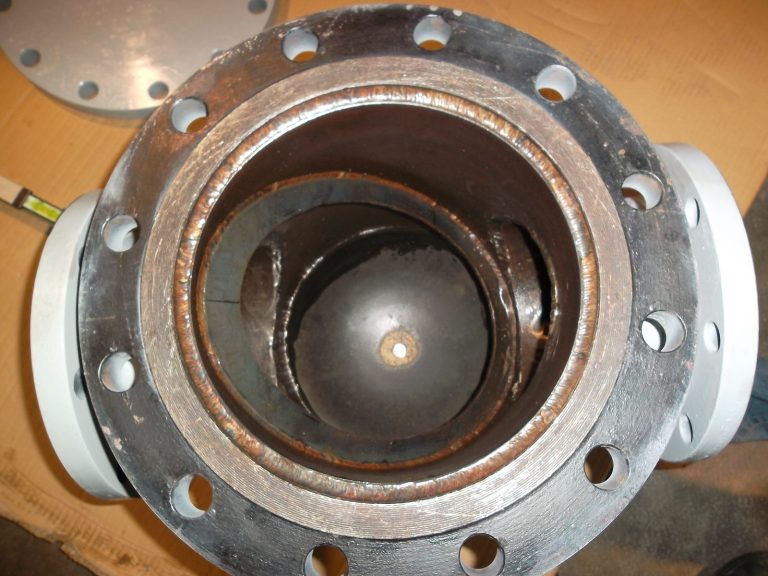
A machined seat between the inlet and the outlet. The rim of the basket lands on it, so all the liquid has to pass through the basket and none can bypass it.
A fabricated shell in carbon steel, SS304 or SS316, designed to ASME B31.1 or ASME VIII Div. 1 and pressure tested.
The strained liquid leaves below the seat, through a flanged outlet on the same centre line as the inlet.
A plugged port on the cover lets the air out when the strainer fills, and can take a pressure gauge.
A threaded drain at the bottom, from 1/4 to 3/4 inch, empties the body before the cover is opened. Flanged drains on request.
A basket strainer works on a simple principle: the liquid enters the basket from above and leaves through its wall, from the inside out. Anything larger than the holes stays in the basket, and because the basket is closed at the bottom, the debris goes out with it when it is cleaned and never falls back into the clean side. The diagram and the six steps below follow the liquid through a simplex strainer.
The liquid enters through the inlet, above the seat, and flows down into the open top of the basket.
It passes through the perforated wall and the mesh lining, from the inside out, and leaves through the outlet below the seat.
Particles larger than the openings are held in the basket and settle at its bottom.
As the basket fills, the pressure difference between the inlet and the outlet rises: a gauge on each side, or a differential gauge, shows when the basket is due for cleaning.
The line is stopped and the valves on each side are closed; the body is vented and drained.
The cover comes off, the basket is lifted out by its handle, emptied and put back on its seat, and the line starts again.
Fabricated bodies designed to ASME B31.1 and/or ASME VIII Div. 1, 150 psig at 150 °F (10.3 barg at 65.6 °C) for the standard range, and pressure tested before dispatch. Higher pressures and temperatures are designed to order.
The basket rim lands on a machined seat between the inlet and the outlet, so nothing can flow past the basket.
A bolted flat cover with a lifting lug as standard; quick-opening covers with hinged eye bolts, and a swing-arm davit for heavy covers, on request.
Heavy-duty perforated stainless steel baskets with a slanted top and a lifting handle: 3 mm holes as standard, or 1/32, 1/16 and 1/8 inch, plain or lined with 20 to 200 mesh.
ANSI B16.5 flanges, RF, FF or RTJ, or butt-weld ends; ANSI 150, 300 and 600 lb. JIS and DIN flanges on request.
Carbon steel, SS304 or SS316 bodies; duplex stainless steel, Alloy 20, Hastelloy C276 and Monel on request. Internal coatings and linings available.
A threaded or flanged drain at the bottom and a vent on the cover. Blowdown connections and extra vents where the duty needs them.
Differential pressure gauges, custom nozzle positions, oversized bodies for a larger screen area, floor stands and special coatings or galvanizing.
Hydrostatic test on every strainer, a fixed part of our QC; dye penetrant, radiographic, ultrasonic wall thickness, magnetic particle and positive material identification, EN 10204 3.1 material certificates, a certificate of conformance and pickling and passivation of stainless steel when the specification asks for them.
A simplex basket strainer protects equipment on lines that can be stopped for a short time to clean the basket. Plants choose a basket strainer rather than a Y-strainer when the line is larger or carries more debris, because the basket holds much more and is easy to lift out. These are the usual duties.
On the suction side of a pump, a basket strainer stops stones, weld slag and scale before they reach the impeller and the seals.
Flow meters, control valves and spray nozzles need clean liquid to stay accurate and to seal; the strainer catches what would wear or block them.
A strainer in front of a heat exchanger keeps debris out of the narrow channels and tubes, where it would block the flow.
Crude and refined oil lines, transfer and loading pumps, and the lines into storage tanks.
Fuel oil, diesel, solvents and process liquids, in carbon or stainless steel to suit the liquid.
Cooling-water, sea-water, process-water and fire-water lines, where sand, shells and scale would damage pumps and nozzles.


Valves on both sides let the strainer be isolated and drained for cleaning; a pressure gauge on each side, or a differential gauge, shows when the basket is due.
For a line that must keep running see the LEAKPROOF duplex basket strainer; for small lines, steam and gas, the LEAKPROOF Y-strainer; for commissioning, temporary cone, basket and plate strainers; for fine particles, the LEAKPROOF polishing filter.
The standard range covers 2 to 12 inches with ANSI 150 lb flanges; larger sizes, 300 and 600 lb ratings, butt-weld ends and other layouts are built to order. We size each strainer for the flow, the liquid and the debris it has to hold.
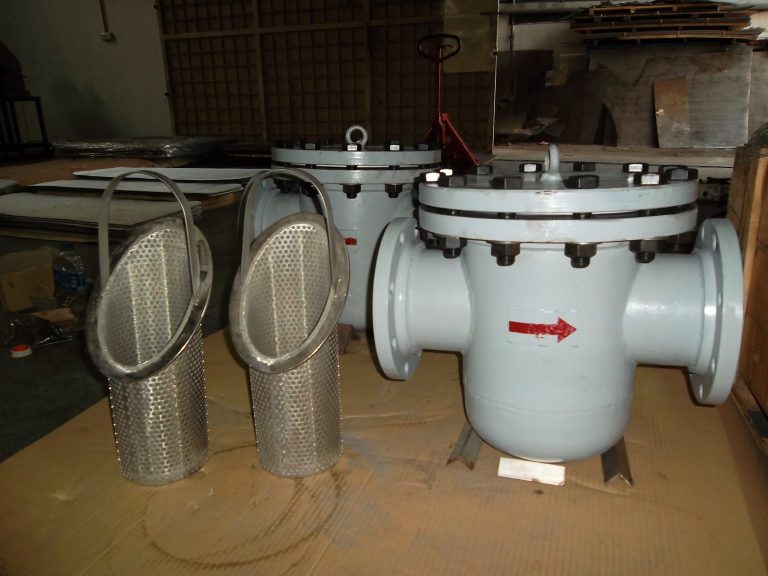
Inlet and outlet on one centre line, a slant-top basket under a bolted cover: the standard design in the table below.
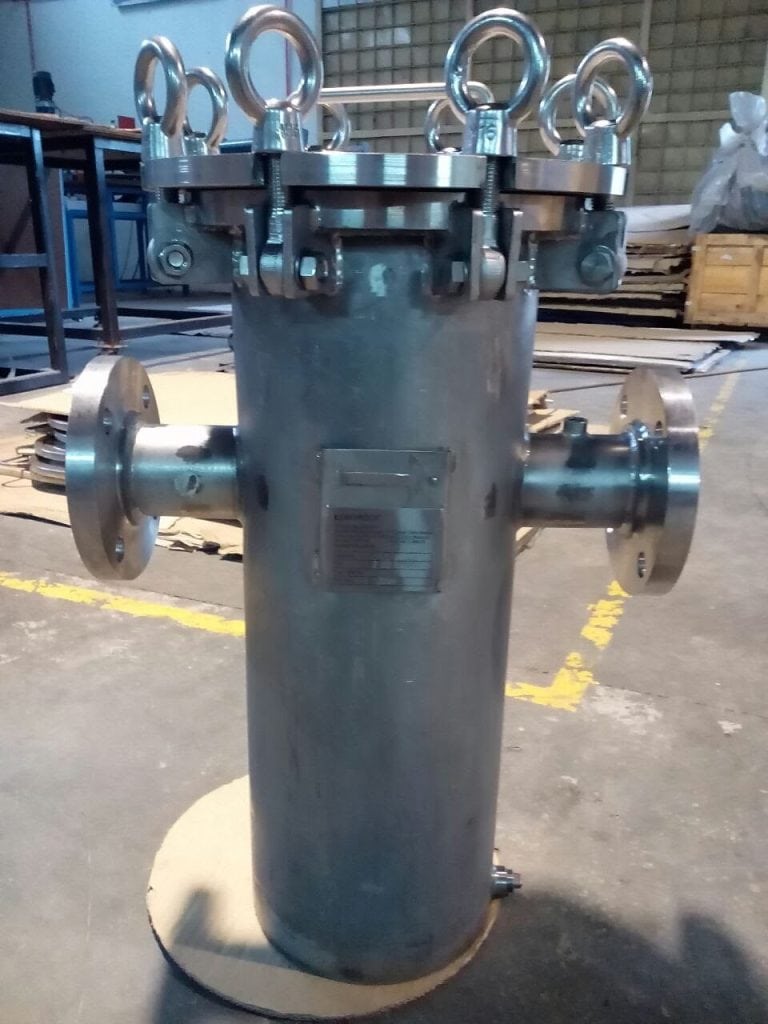
Hinged eye bolts that swing out, for baskets that are cleaned often; a davit carries heavy covers.
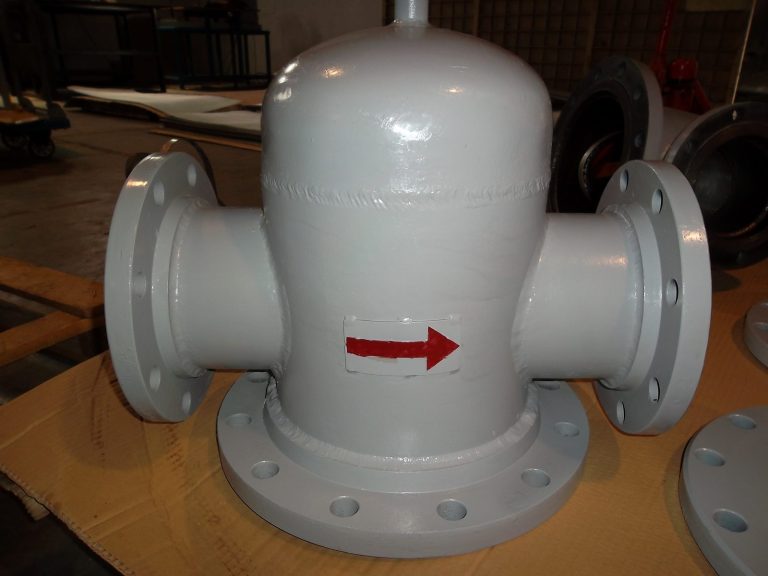
Tee, angle and long in-line bodies built to a project drawing, up to 24 inches and larger.
| Size (in) | A (mm) | B (mm) | C (mm) | D* (mm) | Drain (NPT) |
|---|---|---|---|---|---|
| 2 | 299 | 305 | 203 | 476 | 1/4 in |
| 3 | 330 | 352 | 216 | 686 | 1/2 in |
| 4 | 406 | 352 | 216 | 686 | 1/2 in |
| 5 | 406 | 381 | 238 | 762 | 1/2 in |
| 6 | 508 | 422 | 260 | 812 | 1/2 in |
| 8 | 558 | 530 | 336 | 1042 | 3/4 in |
| 10 | 660 | 654 | 431 | 1270 | 3/4 in |
| 12 | 762 | 759 | 501 | 1473 | 3/4 in |
A: face to face of the flanges. B: height of the strainer. C: base to the centre line of the nozzles. D*: height needed to lift the basket out. The 3 and 4 inch strainers share the 6-inch body, so B, C and D* are the same. ANSI B16.5 flanges, bolt holes straddling the centre lines; all dimensions in mm.
| Body | Carbon steel, SS304 or SS316 (other alloys on request) |
| Design code | ASME B31.1 and/or ASME VIII Div. 1 |
| Design pressure and temperature | 150 psig at 150 °F (10.3 barg at 65.6 °C); higher on request |
| Connections | ANSI B16.5 flanged, RF, FF or RTJ, 150, 300 or 600 lb; butt-weld on request |
| Basket | Perforated stainless steel, 3 mm holes standard; 1/32, 1/16 or 1/8 inch |
| Mesh lining | 20 to 200 mesh |
| Gasket or O-ring | EPDM or Viton |
| Drain | Threaded NPT, 1/4 to 3/4 inch; flanged on request |
| Tests | Hydrostatic on every strainer; DP, RT, UT, MPI and PMI on request |
Dimensions are for the standard strainers and may change; the general arrangement drawing sent with each quotation gives the certified dimensions and weights.
Baskets and their mesh linings are the parts a strainer uses up. We make them in our own works for our strainers and for other makes, to a drawing or a sample, and re-mesh worn baskets.

Perforated baskets with slanted or flat tops and lifting handles, made to fit your strainer body.

Woven mesh baskets and linings from 20 to 200 mesh, made to size and wrapped for dispatch.

A second basket on the shelf means the strainer is back in service as soon as the cover is on.
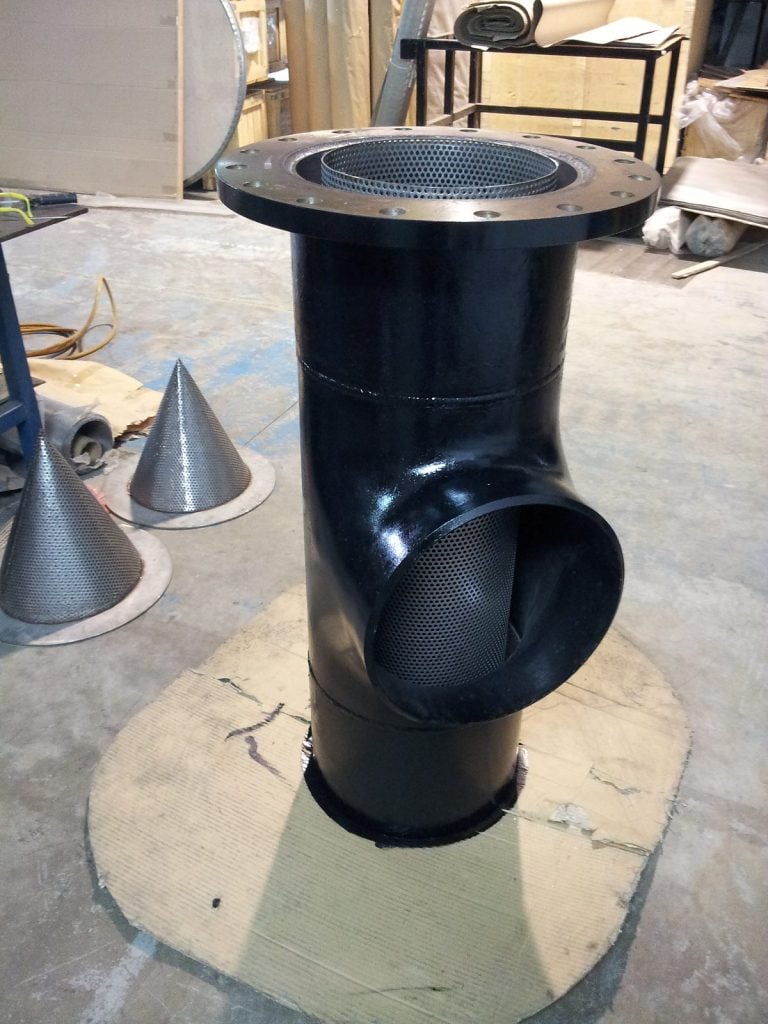
Cone, basket and special elements for strainers of other makes, from a sample or drawing.
It keeps solids such as weld slag, scale, stones and fibres out of pumps, meters, valves and heat exchangers. The liquid flows into a removable basket and out through its perforated wall, and the debris stays in the basket until it is emptied.
A basket strainer holds far more debris and is easier to clean, so it suits larger lines and dirtier liquids. A Y-strainer is more compact and suits small lines, steam and gas, and pipes in any position. Tell us the line size, the liquid and the debris, and we will recommend one.
By what the equipment downstream must be protected from. The standard 3 mm perforated basket protects most pumps; a mesh lining gives a finer cut for meters, nozzles or close-clearance pumps. A finer screen than needed only makes the basket fill sooner.
When the pressure difference between the inlet and the outlet reaches the value set for your line, read on a gauge on each side or on a differential gauge. If the difference drops suddenly, check the basket: a damaged screen or a basket that is not seated lets debris through.
No. The strainer is isolated by the valves on each side, vented and drained before the cover is opened. For a line that has to keep running, choose a duplex strainer, which changes over to a clean basket while the other is cleaned.
The basket rim lands on a machined seat, so no liquid can flow past the basket, and the cover seals on a gasket or O-ring. Every strainer is pressure tested before it leaves our works.
Carbon steel, SS304 and SS316 as standard, and duplex stainless steel, Alloy 20, Hastelloy and Monel on request. ANSI 150, 300 and 600 lb flanges; higher ratings and butt-weld ends are designed to order.
Yes. Send a drawing, a sample or the main dimensions, the perforation or mesh you need and the material, and we will make new baskets or re-mesh your old ones.
Send us your duty, a drawing or a photo of your existing unit. A Peltech engineer will reply with options and a quotation.