

Cast Bodies
Cast iron, cast carbon steel or cast stainless steel (CF8) bodies with flanged ends, in standard sizes from 1 to 12 inches, 2-1/2 inch included.


A Y-strainer protects pumps, control valves, meters, steam traps and burners with a cylindrical screen in a short leg that branches off the pipe at an angle, the shape that gives it its name. It is compact, fits in horizontal or vertical lines and suits steam and gas as well as liquids. LEAKPROOF Y-strainers come as cast bodies with flanged ends in standard sizes, and as fabricated bodies with butt-weld or flanged ends, built in Malaysia in carbon or stainless steel for larger sizes, higher pressures and special duties.
A cast body with flanged ends, or a fabricated body built from pipe and fittings, with butt-weld or flanged ends.
The liquid comes in here. The flow arrow on the body shows which end is the inlet.
The strained liquid leaves on the same centre line, so the strainer fits straight into the pipe run.
A wall across the inside of the body. It leaves the liquid only one way through: into the open end of the screen.
A machined seat in the partition. The open end of the screen lands on it, so nothing can bypass the screen.
A perforated stainless steel cylinder in the leg, plain or lined with mesh. The debris collects inside it.
A bolted cover, or a blind flange on fabricated strainers, closes the leg and holds the screen on its seat.
EPDM or Viton for most liquids; PTFE or spiral-wound gaskets for hot or high-pressure duties.
A threaded plug in the cover empties the screen. A blow-down valve can be fitted in its place.
Marked on the body: the strainer must be fitted with the flow, so that the liquid enters the screen.
A Y-strainer works on the same principle as a basket strainer, laid on its side: the partition sends the liquid into the open end of the screen, and it leaves through the screen wall, from the inside out. The debris is carried down the screen and collects at its closed end, by the cover, where it can be drained or blown down. The diagram and the six steps below follow the liquid through a Y-strainer.
The liquid enters through the inlet; the partition leaves it only one way on, into the open end of the screen.
It passes through the screen wall from the inside out, into the leg, and on to the outlet.
Particles larger than the holes are carried down the screen and collect at its closed end, by the cover.
As the screen fills, the pressure difference across the strainer rises; gauges on each side show when it is due for cleaning.
Where a blow-down valve is fitted and the duty allows it, opening it for a moment flushes the debris out of the screen without taking the strainer apart.
For a thorough clean the line is isolated and drained, the cover taken off and the screen pulled out, washed and put back.
Cast iron, cast carbon steel or cast stainless steel (CF8) bodies with flanged ends, in standard sizes from 1 to 12 inches, 2-1/2 inch included.
Built in our works from pipe and fittings in carbon steel, SS304L or SS316L, for larger sizes, higher ratings and special layouts, designed to ASME B31.1, B31.3 or ASME VIII Div. 1.
The open end of the screen lands on a machined seat in the partition, and the cover holds it there, so nothing flows past the screen.
Perforated stainless steel, 1/32, 1/16 or 1/8 inch holes, plain or lined with 20 to 60 mesh, or with fine mesh from 60 to 300 µm on fabricated strainers.
ANSI B16.5 flanges on cast and fabricated bodies; butt-weld ends bevelled for welding into the line; threaded ends on small fabricated strainers.
ANSI 150 lb as standard; fabricated Y-strainers for 300 and 600 lb, and higher ratings designed to order.
A bolted cover or blind flange with an EPDM or Viton gasket; PTFE or spiral-wound gaskets for hot and high-pressure duties.
A threaded drain plug in the cover, from 1/4 to 3/4 inch; a blow-down valve, vents and differential pressure connections on request.
Hydrostatic test before dispatch; dye penetrant, radiographic, positive material identification, EN 10204 3.1 material certificates, a certificate of conformance and pickling and passivation when the specification asks for them.
A Y-strainer is the usual choice where the line is small, the debris is light, or space is tight. It keeps scale, weld slag and dirt out of the equipment downstream and is cleaned with the line stopped or, where a blow-down valve is fitted, by a short blow-down. These are the usual duties.
In front of steam traps, control valves and heat exchangers, where scale and weld slag would stop a trap or score a valve seat.
On fuel gas, fuel oil and diesel lines to burners and engines, to keep dirt out of regulators, nozzles and injectors.
Ahead of dosing pumps, flow meters and control valves on small lines, where a basket strainer would be too big.
Thermal oil, process liquids and solvents, in carbon or stainless steel, with ratings to suit the line.
Fabricated Y-strainers with butt-weld ends for high-pressure lines, built to the project specification and tested.
Cooling-water, process-water and washdown lines, and compressed air.
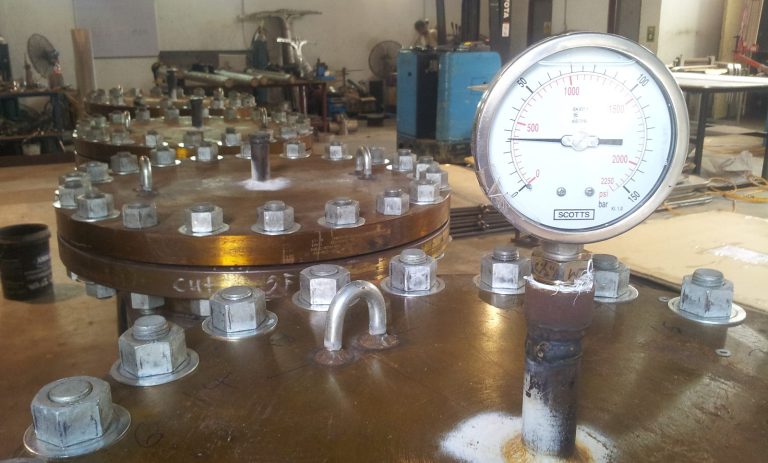
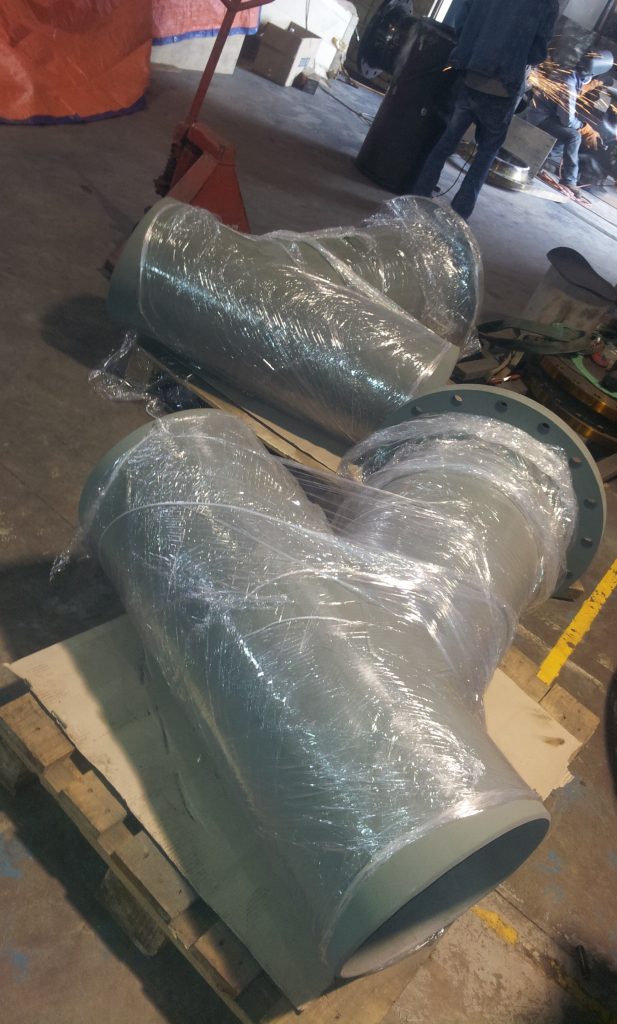
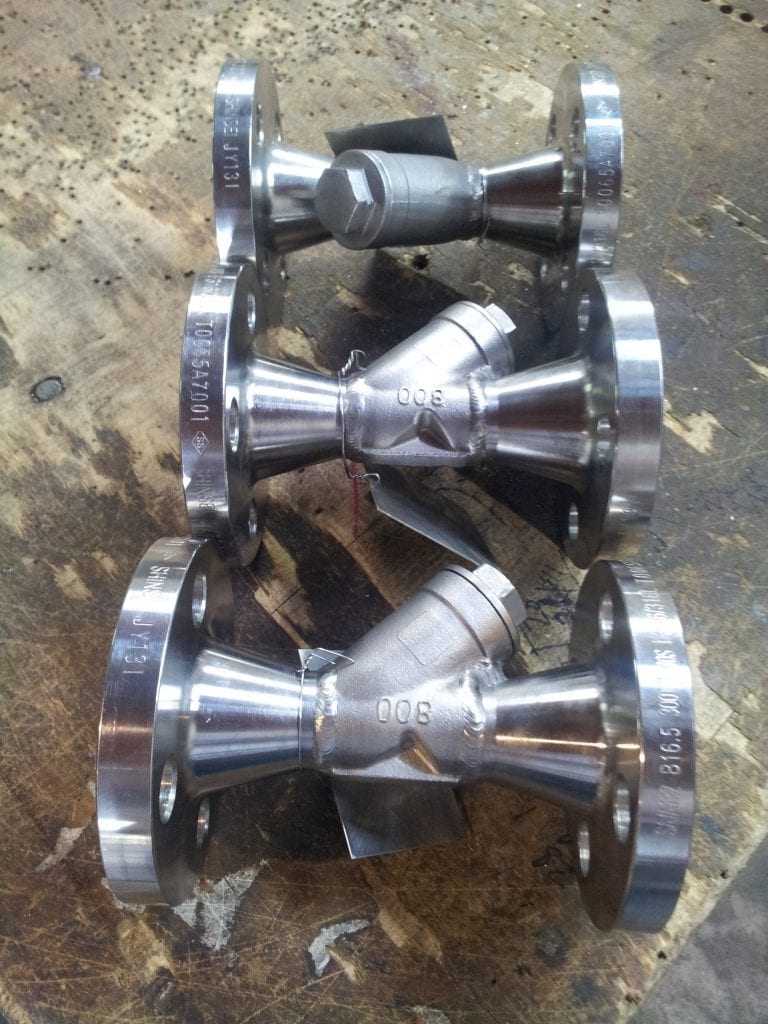
A gauge on each side shows when the screen is due. On steam lines a blow-down valve on the cover is a quick way to keep the screen clear between shutdowns.
For more debris see the LEAKPROOF simplex basket strainer; for a line that must keep running, the LEAKPROOF duplex basket strainer; for commissioning, temporary cone, basket and plate strainers.
Cast Y-strainers cover the common sizes with flanged ends; fabricated Y-strainers are built to order for larger lines, higher ratings, butt-weld ends and special materials. We size each strainer for the line, the flow and the debris.
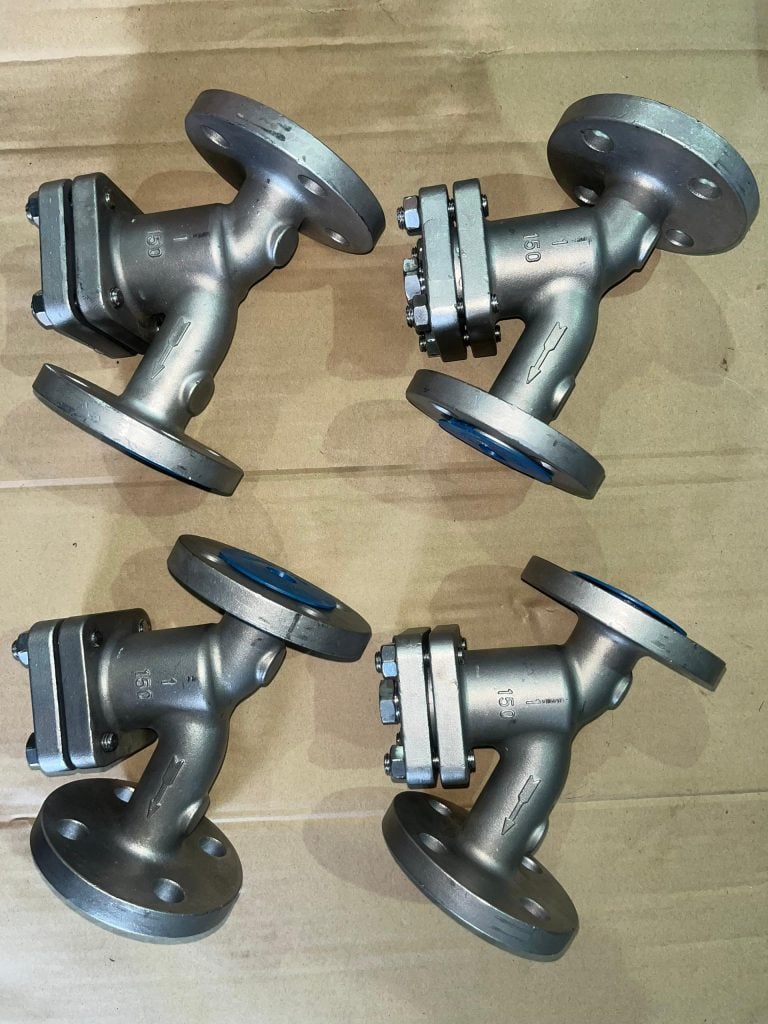
Cast body with flanged ends in standard sizes from 1 to 12 inches, 2-1/2 inch included: the first table below.
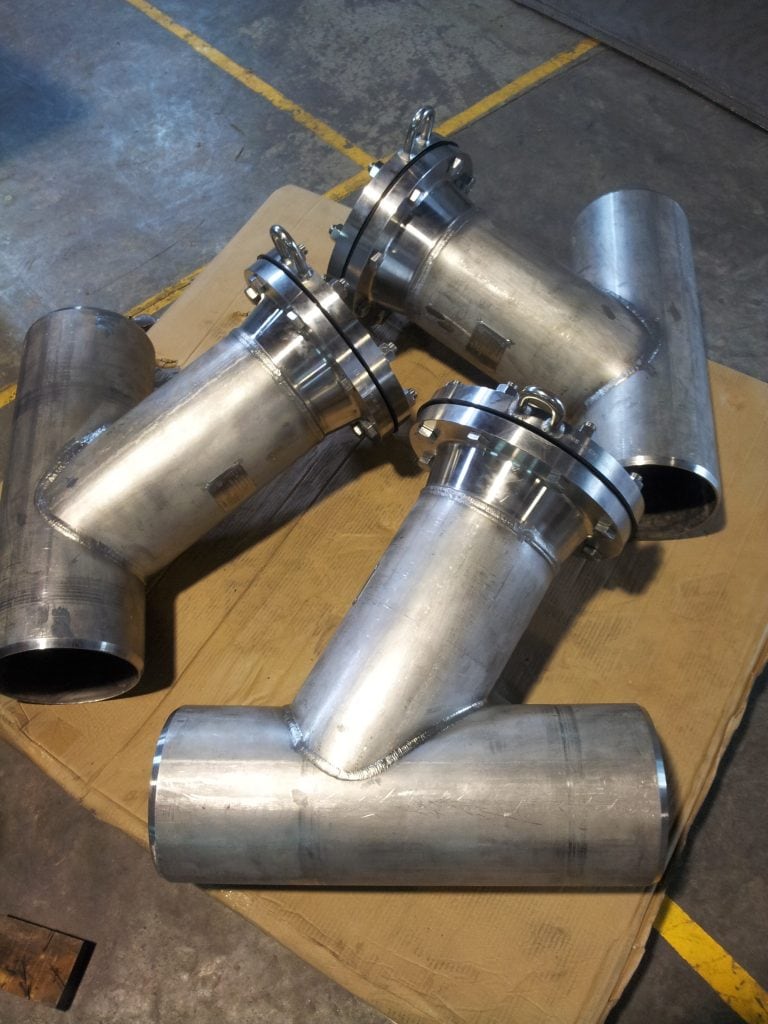
Built from pipe in carbon or stainless steel and welded into the line: the second table.
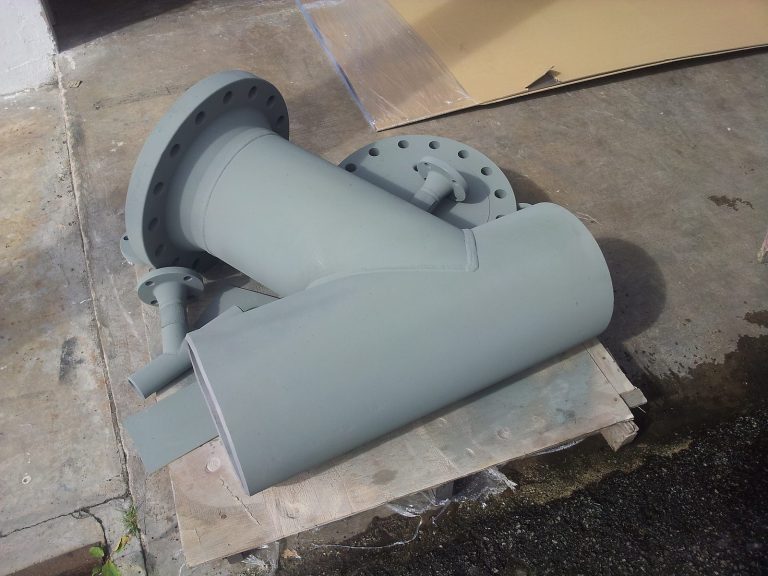
Flanged bodies, larger legs, blow-down valves and higher ratings, built to the project drawing.
| Size (in) | L (mm) | D (mm) | C (mm) | B (mm) | H1 (mm) | Drain (BSPT) | Weight (kg) |
|---|---|---|---|---|---|---|---|
| 1 | 160 | 108 | 79 | 25 | 77 | none | 3.4 |
| 2 | 220 | 152 | 120 | 50 | 128 | 1/2 in | 9.0 |
| 3 | 290 | 190 | 152 | 80 | 200 | 1/2 in | 18.5 |
| 4 | 350 | 229 | 190 | 100 | 240 | 1/2 in | 27.0 |
| 6 | 440 | 279 | 241 | 150 | 300 | 1/2 in | 50.0 |
| 8 | 540 | 343 | 298 | 200 | 410 | 1/2 in | 100.0 |
| 10 | 640 | 406 | 362 | 250 | 475 | 1/2 in | 147.0 |
| 12 | 805 | 484 | 432 | 300 | 600 | 1/2 in | 216.0 |
L: face to face. D: flange diameter. C: bolt circle. B: bore. H1: centre line to the bottom of the cover. Weights are estimates. 2-1/2 inch Y-strainers are also supplied; dimensions on request.
| Size (in) | NPS (mm) | L (mm) | L1 (mm) | H (mm) | Drain (BSPT) | Weight (kg) |
|---|---|---|---|---|---|---|
| 2 | 50 | 290 | 110 | 210 | 1/4 in | 9.5 |
| 3 | 80 | 380 | 140 | 260 | 1/2 in | 20.8 |
| 4 | 100 | 420 | 150 | 300 | 1/2 in | 31.8 |
| 6 | 150 | 520 | 180 | 400 | 1/2 in | 61.5 |
| 8 | 200 | 610 | 210 | 500 | 3/4 in | 108.0 |
| 10 | 250 | 740 | 250 | 600 | 3/4 in | 177.0 |
| 12 | 300 | 820 | 280 | 700 | 3/4 in | 246.0 |
L: end to end. L1: inlet end to the centre of the leg. H: centre line of the pipe to the cover, along the leg. Weights are estimates.
| Body, cast | Cast iron, cast carbon steel or cast stainless steel CF8 |
| Body, fabricated | Carbon steel, SS304L or SS316L (other alloys on request) |
| Ends | ANSI B16.5 flanged; butt-weld or threaded on fabricated strainers |
| Pressure rating | ANSI 150 lb standard; 300 and 600 lb fabricated, higher to order |
| Screen | Perforated stainless steel, 1/32, 1/16 or 1/8 inch holes |
| Mesh lining | 20 to 60 mesh; 60 to 300 µm on fabricated strainers |
| Gasket | EPDM or Viton; PTFE or spiral wound on request |
| Drain | Threaded BSPT plug in the cover; blow-down valve on request |
| Tests | Hydrostatic; DP, RT and PMI on request |
Dimensions are for the standard strainers and may change; the general arrangement drawing sent with each quotation gives the certified dimensions and weights.
Screens are the part a Y-strainer uses up. We make perforated and mesh-lined screens in our own works, for our strainers and for other makes, to a drawing, a sample or the main dimensions.
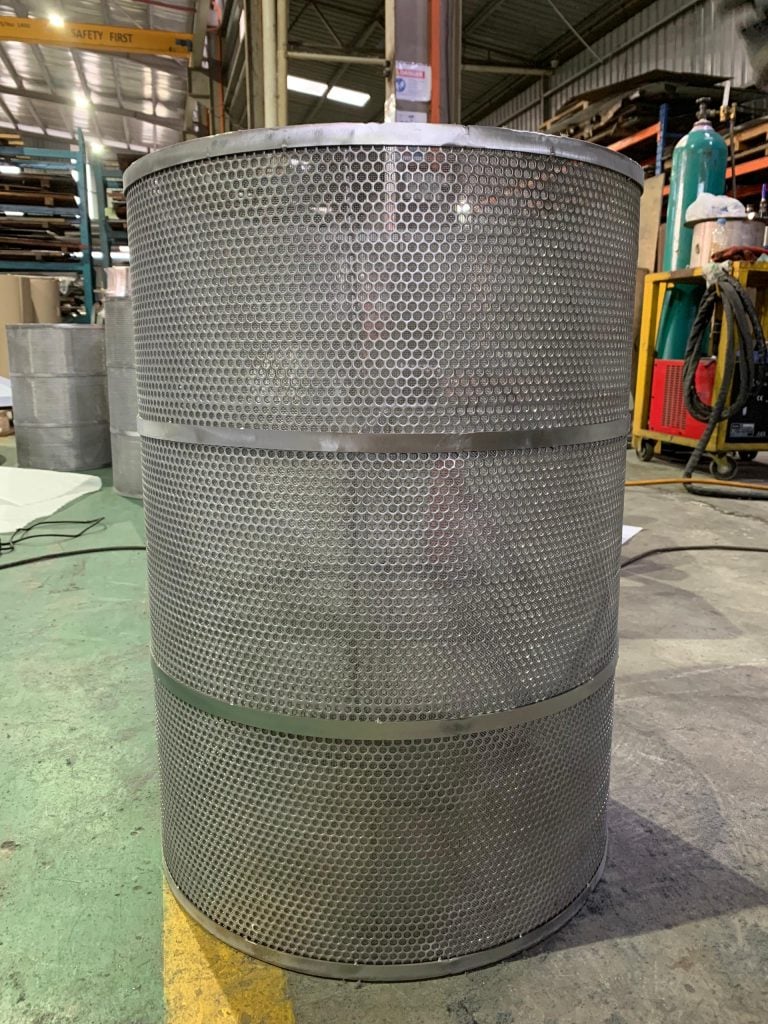
Perforated stainless steel screens made to the length and diameter of your strainer.

Woven mesh screens and linings for a finer cut, made to size.

Worn or torn screens and baskets re-meshed with new woven mesh on the old frame.
It keeps scale, weld slag and dirt out of pumps, control valves, meters, steam traps and burners. The liquid passes from the inside of a cylindrical screen to the outside, and the debris collects in the screen until it is drained or the screen is cleaned.
A Y-strainer is compact, fits horizontal and vertical lines and suits steam and gas; a basket strainer holds far more debris and is easier to clean, so it suits larger liquid lines and dirtier service. Tell us the line, the medium and the debris, and we will recommend one.
With the flow arrow pointing downstream. In a horizontal liquid line the leg points down; in a vertical line the flow must go downwards; on steam and gas lines the leg is often turned to lie on its side. Leave room to take the cover off and pull the screen out.
A valve in place of the drain plug lets the debris be flushed out of the screen by opening it for a moment, without taking the strainer apart. Use it only where the duty allows the release of the line contents, and route the discharge safely.
By what the equipment downstream must be protected from. Perforated screens protect most pumps and valves; a mesh lining gives a finer cut for meters, nozzles and traps. A finer screen than needed only blocks sooner.
Cast Y-strainers come in standard sizes with flanged ends. Fabricated Y-strainers are built from pipe and fittings, so they can be larger, take higher ratings and butt-weld ends, and be made in the material and layout of the project.
ANSI 150 lb as standard. Fabricated Y-strainers are built for 300 and 600 lb, and higher ratings are designed to order; every strainer is pressure tested before dispatch.
Yes. Send the length, diameter, perforation or mesh and material, or a sample, and we will make new screens or re-mesh the old ones.
Send us your duty, a drawing or a photo of your existing unit. A Peltech engineer will reply with options and a quotation.