GALLERY


GALLERY

A LEAKPROOF single-bag polishing filter housing on three legs, with the cover davit, pressure gauge and flanged connections fitted, photographed in the Senai works before packing. The davit swings the cover aside so one person can change the bag; the gauge shows when the bag is loaded and due for a change.

A tall stainless steel multi-bag housing with its cover held down by swing eye bolts, standing on its legs in the workshop. Several bags in one housing give a high flow in a small footprint; the eye bolts let the operator open the housing without tools.

Looking into an open housing with a new filter bag sitting in its support basket. The bag collar seals against the top of the basket so that nothing bypasses, and the basket carries the pressure load so the bag itself only has to filter.

Inside a two-bag housing, with both support baskets in place and the housing floor polished. Each basket sits in its own seat ring; the liquid enters above the baskets and leaves below them, so the bags are changed from the top without draining the pipework.

A finished single-bag housing with its LEAKPROOF nameplate, cover davit and bottom drain, ready for inspection. The nameplate carries the design pressure, test pressure and build year, as required for a pressure vessel.

A single-bag housing standing in the workshop with its cover closed and the inlet and outlet flanges protected for transport. Housings are pressure tested and inspected before the bag and gaskets go in.

A laser-etched stainless steel LEAKPROOF nameplate before the serial number, design pressure and test data are stamped in. Every pressure vessel leaves the works with a plate like this riveted to the shell, so the design and test figures stay with the vessel for its working life.

A handheld XRF alloy analyser showing a 304 stainless steel match, with the fasteners it has just checked behind it. Incoming plate, pipe and fasteners are checked this way so that the grade on the certificate is the grade that goes into the job.

Two inspectors in the works checking a perforated strainer element against its drawing before release. Hole size, open area and the fit of the mesh lining are checked on every element, and the result is written on the drawing that travels with the job.

A rectangular knitted-mesh demister pad being measured against its drawing before packing. Pads are made to the vessel’s inside dimensions with a few millimetres of interference so they seat firmly in the support grid.

A custom stainless steel enclosure with two oval inspection windows and a gasketed door, built in the fabrication shop. The same sheet-metal and welding skills that make filter housings go into enclosures, hoods and guards for plant equipment.

A three-deck AlphaScreen circular separator assembled on its painted base in the Senai works, with the clamp rings holding the deck frames together. Three decks give four product fractions from one machine.

A two-deck AlphaScreen separator on its base frame, ready for the no-load test run. Each machine is run in the works to set the motor weights and check the screen pattern before it leaves.

A row of new vibratory motors waiting to be fitted to AlphaScreen separators. The motor hangs under the screen table and its adjustable top and bottom weights set how the material travels across the screen.

The painted lower table weldment of an AlphaScreen separator, with the centre hub that carries the vibratory motor. The table is fabricated from plate, stress relieved and machined flat so the screen frames seat evenly.

An AlphaScreen screen frame seen from above, with the mesh tensioned over the frame and the centre dome that spreads the feed. Frames are re-meshed in the works when the screen wears, so the same frame serves for years.

An assembled AlphaScreen separator on the workshop floor with its clamp rings, outlets and base frame in place. The separator is built, run and packed in Senai.

A thick round knitted-mesh demister pad with its top and bottom support grids, made in one piece for a vessel with a full-diameter manway. The grid bars are tied through the pad so it can be lifted and seated without distorting the mesh.

A round demister pad made in three segments so it will pass through the vessel manway and be assembled inside. The segments overlap at the joints so there is no straight gap for droplets to escape through.

A round demister pad in two halves with its support grids, laid out for final checking. Two-piece pads suit vessels with a larger manway; each half is numbered so the site crew fit them the way they were made.

A box-type demister with the knitted mesh held in a rectangular stainless frame, for a duct or a rectangular vessel. The frame bolts to the vessel so the pad can be pulled out as one piece for cleaning.

A rectangular knitted-mesh demister pad before its grids go on, showing the layered wire mesh that catches the droplets. The mesh density and wire size are chosen for the gas velocity and the liquid load.

A round demister pad with its support grid, ready for packing. The grid carries the pad across the vessel diameter and lets it be lifted in one piece.

Round sections of structured packing laid out across the workshop floor for checking before they are stacked into layers. Each section is numbered to its position in the bed, so the layers go into the column rotated as designed.

A stack of structured packing layers tagged for one column bed, with each layer rotated to the next. The corrugated sheets are made and assembled in the works; the tags tell the site crew the order of installation.

A single block of structured packing, showing the corrugated sheets stacked edge to edge. The sheets give a large surface for the liquid and the vapour to meet, at a low pressure drop.

A complete round layer of structured packing assembled from segments, lying on the floor for a final check of the diameter and the wall wipers. The wipers close the gap between the packing and the column wall.

A large perforated sieve tray on the floor of the works, made in segments that bolt together inside the column. The hole pattern is cut to the process design, and the segments are trial-fitted before they are packed.

Wedge-wire support grids for a packed bed, stacked on a pallet with lifting slings for the truck. The grids carry the weight of the packing and the liquid, and the wedge-wire profile keeps the open area high.

Another stack of structured packing layers for a column bed, tagged and wrapped for transport. Layers are made to the column’s inside diameter and checked against the drawing before they leave the works.

A stainless steel LEAKPROOF simplex basket strainer with flanged ends and a cover davit, finished in the works. The davit takes the weight of the cover so the basket can be lifted out for cleaning by one person.

A large fabricated Y-strainer in carbon steel, blasted and painted, with flanged ends and a bolted cover. Fabricated strainers suit sizes and pressure ratings beyond the cast range.

A horizontal stainless steel strainer housing with flanged inlet and outlet and a quick-opening cover, laid on paper for inspection. The horizontal layout keeps the cover at working height on a low pipe run.

Three temporary cone strainers with mounting flanges on the inspection bench. The cone shape gives a large screen area in a short length; these are fitted between flanges during start-up to catch weld slag and debris.

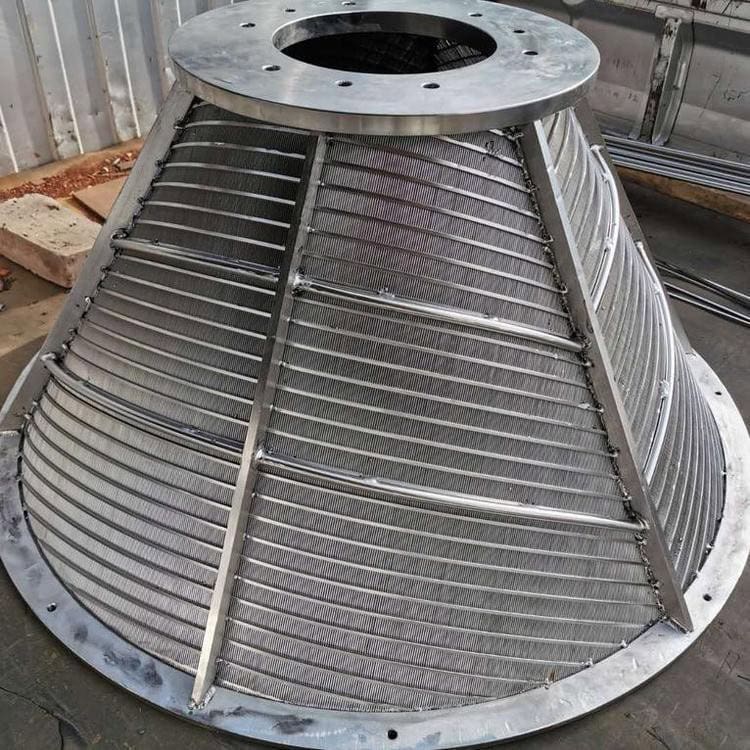
A tall cone strainer made in two stages, with a perforated backing and a fine mesh lining. The length gives the open area needed when the pipe is large and the mesh is fine.

Three basket strainer elements with lifting handles, each a perforated shell lined with mesh. The handle lets the basket be lifted straight out of the housing; the mesh sets the particle size that is held back.

A batch of cylindrical filter elements with end flanges, lined up for checking before dispatch. Elements are made to the housing drawing so that a replacement from Peltech drops straight into an existing filter.

Stainless steel mesh baskets with latched lids, stacked after fabrication. Baskets like these are made for parts washing, screening and sampling, in the mesh size the customer specifies.

Two perforated cone strainers standing on their flanges in the works. The perforated plate is rolled and welded into the cone, then the flange is fitted and the seam dressed.

A stack of new rectangular filter leaves with lifting hooks, on a pallet in the Senai works. Each leaf is a riveted stainless frame with drainage mesh inside and fine filter cloth outside; the hooks hang the leaf in the filter.

A single rectangular filter leaf on the bench, with the central divider bar and the outlet neck that connects the leaf to the filter manifold. The neck is machined to the manifold’s seat so the leaf can be changed without tools.

Stainless steel shell of a vertical pressure leaf filter in the Senai workshop, lying on its side while the swing-bolt eyes are welded around the dished top cover and the support lugs around the shell, with a second unit behind it. Vessels of this type are fabricated lying down and stood up on their lugs only at installation. The shell, cover and nozzles are fabricated and welded in-house before the leaf set, manifold and closure are fitted. Vessels are designed to ASME VIII Division 1 and can be registered with DOSH (JKKP) for use in Malaysia.

Two stainless steel pressure leaf filter vessels with conical bottoms outside the works, ready for internals and final inspection. The cone collects the filter cake and sludge so the vessel can be drained and cleaned between cycles. Shells of this type are rolled, welded and hydrotested in Senai.

Two horizontal pressure leaf filters, painted and wrapped at the nozzles, waiting for the container. Carbon steel vessels are blasted and painted to the customer’s specification; stainless vessels are pickled and passivated instead. Each unit ships with its hydrotest and material records.

A new LEAKPROOF vertical pressure leaf filter vessel in the workshop, lying on temporary stands with the swing-bolt top closure, nozzles, side support lugs and conical cake-discharge bottom fitted. In service the vessel stands upright on its lugs and the cake drops out through the bottom outlet flange. The quick-opening cover lets the operator open the vessel for leaf inspection without unbolting a flange. The vessel is designed to ASME VIII Division 1 and hydrotested before dispatch.

A dished vessel head fitted with a davit arm and a central handwheel closure, during a vessel refurbishment. The davit swings the head clear so the internals can be reached, and the handwheel pulls the head down onto its gasket. Peltech repairs and modifies existing filter vessels as well as building new ones.

A vertical knock-out drum fabricated in stainless steel, with flanged inlet, outlet and drain nozzles and a bolted top cover. Drums like this remove liquid droplets from a gas stream and are usually fitted with a Peltech demister pad or vane pack. Fabrication, welding and testing are done under the ISO 9001 system.

View through a flanged nozzle into a leaf filter vessel, showing the internal pipe and the pickled surface of the shell. Nozzle welds are made from both sides where access allows and are checked by dye penetrant testing. Welding is carried out to ASME IX procedures.

A horizontal pressure leaf filter with a hydraulic cylinder that pulls the leaf bundle out of the shell on rails. The operator can inspect, clean or replace leaves without lifting equipment. The LEAKPROOF filter is built for bleaching earth and nickel catalyst filtration in edible oil refineries.

A LEAKPROOF pressure leaf filter with swing-bolt closure and top manifold at a refinery in Malaysia, photographed at hand-over. The vessel was fabricated, hydrotested and fitted with its leaf set in Senai before delivery to site. The swing bolts let the head be opened without tools.

Looking down into a vertical leaf filter with a full set of filter leaves hung from the outlet manifold. The leaves sit at equal spacing so the cake builds up evenly on both faces of each leaf. Peltech supplies leaf sets for its own filters and as replacements for other makes.

A stack of large rectangular filter leaves ready for packing. Each leaf is a riveted stainless steel frame with a coarse support mesh inside and a fine filter mesh on both faces. The outlet neck at the bottom of each leaf connects to the filter manifold.

A cut-away sample of a LEAKPROOF filter leaf showing the layers: the frame, the coarse inner support mesh, and the fine outer filter cloth. The layers are riveted together through the frame so the leaf stays flat and the cloth does not lift at the edge. Leaves are made in 304 or 316 stainless steel to suit the process.

A single rectangular filter leaf with a central divider bar and outlet neck, photographed before packing. The divider stiffens the leaf and keeps the two mesh faces in tension. Leaves are made to the customer’s drawing or taken from a sample so they drop straight into the existing filter.

The outlet necks of a set of filter leaves, which seat on the filter manifold with O-rings or gaskets. The neck takes the weight of the leaf and the cake, so it is welded to the frame and leak-tested. Worn necks are a common reason for re-building a leaf set.

A set of leaves for a vertical leaf filter standing on a trolley after final inspection. Leaves for vertical filters hang from the top and are located at the bottom, so the frame and the hanger are checked for squareness before the set is packed.

A set of filter leaves packed in a timber crate with spacers between each leaf. The crate protects the filter cloth from being pressed or scuffed in transit. Leaf sets are shipped to refineries in Malaysia, Singapore, Indonesia and further afield.

A batch of single-bag filter housings on legs, with flanged inlet and outlet and a swing-bolt cover. The housings polish liquids after the main filter and take standard size 1 and size 2 filter bags. Housings are built in 304 or 316 stainless steel.

The swing-bolt cover of a bag filter housing, with the lifting lug on top. The cover is released by loosening the eye bolts and swung aside to change the bag. A gasket in the cover seals the housing at the design pressure.

A pleated (star) basket element next to a plain perforated basket. Pleating multiplies the filtration area inside the same housing, so the element runs longer between cleanings. Elements are made from perforated plate and wire mesh in stainless steel.

A multi-bag polishing filter vessel with a davit-mounted cover and flanged nozzles. Several bags in one vessel give a high flow in a small footprint, typically as a final polish before storage or shipment. The vessel is designed to ASME VIII Division 1.

Cleanable stainless steel filter cartridges made from perforated tube and wire mesh. They replace disposable cartridges where the fluid is hot or the solids can be backwashed off. Cartridges are made to fit the customer’s existing housing.

A fabricated Y-strainer with flanged ends and a bolted screen cover. Y-strainers protect pumps, meters and valves from pipe scale and weld debris and are supplied with a perforated or mesh-lined screen. Fabricated units cover sizes and pressure classes that cast strainers do not.

A batch of fabricated basket strainers with flanged inlet and outlet, before the covers are fitted. Each body is a tee with a removable basket that collects debris; the flow enters the basket from the top and leaves through the side. Peltech has supplied strainers of this type to plant and site contractors across the region.

Two stainless steel tee strainers with heavy blind-flange covers for a high-pressure line. The cover is sized to the same class as the line flanges and sealed with a spiral-wound gasket. Bodies are hydrotested before the screens go in.

A painted carbon steel basket strainer with the stainless steel basket standing beside it. The basket is perforated plate, lined with a finer mesh where the process needs it, with a handle for lifting out. Strainers are painted to the customer’s coating specification.

Two large simplex basket strainers with eye-bolt covers, built for a cooling-water line. The quick-release cover lets the operator lift out the basket for cleaning without tools. The bodies are fabricated from stainless steel plate and pipe.

A duplex basket strainer: two baskets in parallel with change-over valves so one basket can be cleaned while the other stays in service. Duplex strainers suit lines that cannot be shut down, such as fuel oil and lubrication systems. The unit is fabricated in stainless steel.

A set of temporary cone strainers in perforated stainless steel with flat handles. They are fitted between flanges during commissioning to catch debris left in new piping and removed once the line runs clean. Cones are made to the pipe size and flange rating, with mesh lining if needed.

Temporary strainers in two forms: the cone for high flow and low pressure drop, and the flat plate strainer where there is no room for a cone. Both are made from perforated plate with a mesh lining and a handle that sits between the flanges.

A batch of pan (paddle) strainers laid out for inspection. The pan strainer is a flat disc of mesh in a ring with a handle, fitted between flanges as a temporary strainer. These were made in a range of pipe sizes for a plant start-up.

A large fabricated Y-strainer, painted, with a bolted cover on the branch. Fabricated Y-strainers are used where the line size or pressure class is beyond standard cast strainers. The screen is a perforated cylinder lined with mesh.

A row of AlphaScreen circular vibrating separators in the workshop. Each unit has a stainless steel frame, screen decks with clamp rings, and a vibrating motor in the base. AlphaScreens are used in palm oil mills to screen crude oil and sludge, and in food and chemical plants for sieving powders and liquids.

A two-deck AlphaScreen separator with side outlets for the oversize and the fines. Two decks give three fractions in one pass. The screen decks are quick-release so the mesh can be changed in minutes.

A three-deck AlphaScreen with clamp rings between the decks and the motor base below. The separator sorts a feed into four fractions, each leaving through its own outlet. Units are built in Senai and given a running test before dispatch.

Rows of AlphaScreen frames and screen rings on the shop floor. The frames are rolled from stainless steel sheet, welded and ground before the screens are fitted. Batch production keeps delivery times short for mills ordering several units.

The base of an AlphaScreen with the screen frame lifted off, showing the vibrating motor mounted under the table and the springs that isolate the frame from the base. Eccentric weights on the motor set the pattern of movement on the screen, and adjusting them changes how the material travels across the mesh. Motors and springs are stocked as spares.

A stack of replacement screen decks for circular separators. Each deck is a stainless steel ring with the mesh bonded and tensioned on it, and a centre plug. Peltech re-meshes screens for its own AlphaScreens and for other makes of separator.

A finished screen deck with its white food-grade gasket fitted. The gasket seals the deck against the frame so fines do not bypass the mesh. Screens are made in a range of mesh counts and in 304, 316 or 430 stainless steel.

A linear (rectangular) vibrating screen with twin vibrating motors on a steel base. Linear screens handle higher tonnages than circular units and are used for dewatering and sizing. This unit was built for a plant in Malaysia.

Sections of a knitted wire mesh demister pad before the support grids are fitted. The layered knitted mesh catches liquid droplets from a gas stream, which drain back as larger drops. Pads are made in stainless steel and other alloys to suit the vessel.

A small demister in a flanged ring, made to sit between the flanges of a vent or vapour line. The knitted mesh is held by a cross bar and the ring is machined to the flange standard. Units like this are supplied from 2 inch upward.

Close-up of the knitted wire mesh used in demister pads. The loops of wire give a large surface area with an open structure, so droplets are caught without a large pressure drop. The wire diameter and density are chosen to suit the gas velocity and droplet size.

A batch of round demister pads with their support grids tack-welded on. The grid holds the mesh flat in the vessel and takes the load of the gas flow. Small pads like these go into knock-out pots, vents and compressor suction drums.

A small knitted mesh demister pad, photographed before the grids are fitted. The pad is built up from layers of knitted mesh, wound and pressed to the specified density. Pads this size are used in small separators and sample systems.

A vane-type mist eliminator: a box of parallel chevron plates in a stainless steel frame. Gas passes between the plates and the droplets are thrown onto the plate surface and drained away. Vane packs are used where the gas carries heavy liquid loads or solids that would block a mesh pad.

Vane mist eliminator sections fitted inside a horizontal separator vessel, supported on beams welded to the shell. The sections are sized to pass through the manway and bolted together in place. Peltech supplies the internals and the support frames.

A large-diameter demister pad laid out in sections on the workshop floor for a final fit-up check. The pad is split into segments that pass through the vessel manway and are joined inside. Peltech has made refinery demisters up to 2.74 m in diameter.

A trough-type liquid distributor for a packed column, with the parting box and troughs in stainless steel. The distributor spreads the liquid evenly over the packed bed below it, which is what makes the packing work. Distributors are built to the column drawing and checked for level before dispatch.

A packing support grid for a packed column, crated for delivery. The grid carries the weight of the packing and the liquid on it while leaving an open area for the vapour. Grids are made in segments to pass through the manway.

A large-diameter sieve tray assembled on the shop floor for a fit-up check. The tray is built from panels that bolt together inside the column, with downcomers and support rings. Peltech makes sieve, valve and bubble-cap trays for refineries and chemical plants.

Bubble-cap tray sections with risers, caps and downcomer frames, laid out before packing. Bubble caps keep a liquid level on the tray at low vapour rates, so the trays are used in columns with a wide operating range. The trays are stainless steel.

Close-up of the bubble caps on a tray: the vapour rises through the riser, turns under the cap and bubbles out through the slots into the liquid. Caps are pressed and welded from stainless steel sheet.

A module of structured packing made from corrugated stainless steel sheet. The sheets are stacked at alternating angles so vapour and liquid mix across the whole cross-section. Modules are cut to the column diameter and installed in layers, each rotated to the one below.

A pipe-type liquid distributor installed above the packed bed inside a refinery column, during a turnaround. The team fitted the packing, the distributor and the hold-down grid through the manway and checked the levels before the column was closed. Peltech carries out structured packing installation on site.

Looking down a refinery column after the internals have been fitted, with the new support ring visible at the bottom. Site work of this kind is planned around the plant shutdown so the column is back on line in days. The photo was taken during a 2023 turnaround in Malaysia.

The test gauge on a fabricated strainer body. Every pressure-holding body is hydrostatically tested before dispatch, and the test record goes with the delivery documents.

A hand-held analyser checking the alloy of a perforated element before it is built into a strainer. Positive material identification confirms the grade of stainless steel where the customer specifies it, in addition to the mill certificates. The result is recorded against the job.

Positive material identification on a roll of knitted wire mesh before it is made into a demister pad. The check matters most for alloy pads such as Monel, Inconel and 904L, where the wrong wire would not be visible. Mill certificates are kept with the job file.

Dye penetrant testing of a nozzle weld on a stainless steel strainer body. The red dye shows any surface crack or porosity in the weld before the part is painted or passivated. Welding is done to ASME IX procedures by qualified welders.

A conical-bottom vessel in the workshop with nozzles and the manway fitted, before pickling. The shell was rolled from plate and the cone formed in segments and welded. The vessel is designed to ASME VIII Division 1.

A filter leaf frame on the re-meshing jig, with new mesh laid over it before riveting. Old leaves are stripped, the frames straightened and cleaned, and new support and filter mesh fitted. Re-meshing restores a leaf set at a fraction of the cost of new leaves.

Two carbon steel vertical pressure leaf filter vessels with swing-bolt closures and conical bottoms, standing under cover before blasting and painting. Each shell carries a side manway for leaf inspection and a cone outlet for cake discharge. The vessels are designed to ASME VIII Division 1 and were hydrotested before paint.

A long horizontal stainless steel vessel with two manways and flanged nozzles, on its saddles in the workshop. The shell was rolled from plate in courses, with the circumferential seams ground flush inside where the internals sit. Long vessels are built in sections so each course can be rolled and welded on the shop floor.

A stainless steel dished head with its bolting flange and lifting lugs, ready to go onto a vessel. The knuckle radius and the flange face are checked against the drawing before the head is fitted. Heads are pressed to the ASME VIII Division 1 profile for the design pressure.

A large flanged nozzle on a carbon steel vessel with a cross-plate vortex breaker inside. The breaker stops a vortex forming at the outlet so the pump downstream does not draw gas. The nozzle and plate were fitted during a vessel refurbishment.

Two stainless steel shell courses rolled from plate, with the longitudinal seams tacked ready for welding. Rolling to a true circle matters because the vane pack inside must seal against the shell. Plate is cut, rolled and welded in-house.

The shell of a horizontal knock-out drum with the inlet, outlet and drain nozzles tacked in place. Nozzle positions are set out from the drawing and checked before the full welds are made. The drum was built for a gas plant and designed to ASME VIII Division 1.

A large flanged inlet nozzle welded into the shell of a knock-out drum, with the reinforcement blended into the shell. The set-in nozzle is welded from both sides and checked by dye penetrant. The flange is machined to the specified pressure class.

Looking through a knock-out drum after welding and pickling, with the vane-pack support ring already in place. The inside surface is cleaned so the vane pack and demister seat properly and nothing is left to corrode. The internals are fitted through the end flange.

A pressed stainless steel dished end in the workshop, blank and ready for nozzles and the shell seam. Ends are formed to the ASME VIII Division 1 profile and checked for thickness after forming. This one went onto a pressure leaf filter shell.

A conical bottom section rolled and welded from stainless steel plate, with the outlet at the apex. The cone goes under a vertical leaf filter where it collects the cake for discharge. Cones are formed in segments where the diameter is too large for one plate.

A row of painted horizontal vessels on their saddles, lined up outside the works for dispatch. Building several identical vessels in one run keeps the jigs set up and the welding consistent across the batch. Each vessel was hydrotested and documented separately.

A stainless steel horizontal vessel with dished heads and flanged nozzles, on its saddles in the workshop before pickling. Vessels of this type hold or settle oil in a refinery and are designed to ASME VIII Division 1. The saddle spacing is set to suit the customer’s foundation.

A horizontal vessel with a conical end and bottom outlet, built for an edible oil refinery. The cone lets the vessel drain fully, which matters when the contents set when cold. The shell, cone and head were fabricated and welded in Senai.

Close-up of the quick-opening closure on a horizontal leaf filter shell: the closure ring, the gasket seat and one of the swing bolts. The ring is machined after welding so the gasket face is flat and true. This closure lets the operator open the filter in minutes.

A horizontal pressure leaf filter shell with its nozzles welded, after pickling and passivation. Pickling removes the heat tint from the welds so the stainless steel keeps its corrosion resistance. The shell is ready for the closure, the leaf set and the hydrotest.

The hinged door of a horizontal leaf filter with its latch and the hydraulic opening cylinder behind. The door swings clear so the leaf bundle can be pulled out on its rails for inspection. Hinges and latches are sized for the door weight and the design pressure.

Looking into a vertical pressure leaf filter during a change-out, with the old leaf set still in place. The leaves hang from the manifold at the top and are lifted out one by one. Peltech supplies replacement leaf sets and carries out the change-out on site when asked.

Close-up of a closure ring segment after machining, showing the bearing face and the weld between segment and ring. Faces are machined flat so the load is shared evenly around the ring. The closure is proved at the vessel hydrotest.

The hydraulic kit for a leaf filter’s opening mechanism: cylinder, hand pump, hoses and fittings laid out for inspection before fitting. The cylinder pulls the leaf bundle out of the shell on rails. The kit is supplied with the filter or as a retrofit to an existing one.

A butterfly valve with pneumatic actuator, supplied with a leaf filter for the filtrate or discharge line. The actuator is linked to the filter’s control sequence so the valve opens and closes with the cycle. Valves are supplied with the filter or as spares.

A stack of filter leaves on the bench after re-meshing, each with new support mesh and filter cloth riveted to the frame. The stack is checked for flatness and the necks for sealing before the leaves are packed. Re-meshing restores an old set at a fraction of the cost of new leaves.

The top manifold of a vertical pressure leaf filter on site, with the leaf outlets connected along its length. Each leaf drains into the manifold and the manifold carries the filtrate out of the vessel. The manifold is supplied with the leaf set so the outlets line up.

Close-up of a round filter leaf with its lifting hooks and the riveted edge channel. The hooks let the leaf be lifted straight out of a vertical filter. Round leaves are used in filters where the leaves are stacked on a central shaft.

A horizontal pressure leaf filter with its swing-bolt head closed, outside the works before dispatch. The head carries the leaf outlets and the opening gear. The filter was built for an edible oil refinery and hydrotested before painting.

A stack of vertical filter leaves with lifting hooks, each marked with its length before packing. Leaves in one set differ in length to follow the curve of the vessel. Each leaf is numbered so the set goes back into the filter in the right order.

A LEAKPROOF multi-bag polishing filter housing with its swing-bolt cover, lifting handle and nameplate, finished in the workshop in 2017. The cover is held by eye bolts so the bags can be changed without tools. Housings are built in 304 or 316 stainless steel and hydrotested before dispatch.

A single-bag LEAKPROOF filter housing with flanged inlet and outlet, standing on three legs. The bag is changed from the top through the quick-release cover, and the legs keep the drain clear of the floor. Built for a polishing step in a process plant.

A multi-cartridge housing with the cover off, showing the spring hold-down on each cartridge. The springs keep the cartridges seated on the tube sheet so nothing bypasses when the flow pulses. The O-ring seat for the cover runs around the rim.

Looking down into a multi-cartridge housing with seven pleated cartridges in place, each held by a spring. Several cartridges in one housing give a high flow in a small footprint. The housing and tube sheet are stainless steel.

Three multi-bag polishing filter housings on their legs outside the works, finished and ready for dispatch in 2018. Building a batch together keeps the covers, legs and nozzles identical across the set. Each housing is pressure tested and tagged.

Six LEAKPROOF bag filter housings standing in their crate before the lid goes on. The crate holds each housing upright so the covers and nozzles are protected in transit. The batch left the works in 2020.

Three cartridge and bag filter housings with flanged connections lined up on the shop floor in 2020. The tall body takes long cartridges and the domed cover lifts off for changes. All three are stainless steel and were pressure tested before dispatch.

A multi-cartridge housing with its domed cover swung aside, showing the string-wound cartridges seated in the tube sheet. The davit carries the weight of the cover so one operator can open the housing. The seal ring sits in a machined groove in the flange.

A multi-cartridge housing with its cover on a davit arm, which swings the cover clear for a cartridge change. The davit replaces lifting gear on housings too heavy to open by hand. The housing was built in stainless steel in 2020.

Looking into a bag filter housing at the perforated support basket and the O-ring seat on the rim. The basket carries the bag against the pressure drop and the O-ring seals the cover. The inside is pickled so the housing stays clean in service.

A batch of multi-cartridge housings seen from above with the covers off and the cartridges fitted, ready for a final check before shipping. Housings are made in batches to a common drawing, which keeps the price down for plants with several polishing points.

A batch of cylindrical stainless steel vessels wrapped and palletised for shipment. Building identical vessels in one run keeps the jigs set up and the welding consistent across the batch. Each vessel is checked and tested before wrapping.

Two cylindrical stainless steel vessels with their end covers set out beside them before packing. The covers are matched to their vessels after machining so the bolt holes line up. The shells were rolled and welded in the Senai workshop.

A rolled stainless steel shell with its internal plates, covers and bolts laid out for inspection, in front of finished vessels wrapped for shipment. Every part is checked against the drawing and packed as one set so assembly on site is straightforward.

A cylindrical stainless steel vessel with a flanged side nozzle near the bottom and its end cover, standing in the workshop before packing. The shell is rolled from plate and welded in-house. Each vessel is checked and tested before dispatch.

A fabricated stainless steel basket strainer with flanged inlet and outlet and a lifting handle on the bolted cover. The basket lifts out through the top for cleaning without disturbing the pipework. The body is hydrotested before dispatch.

A multi-cartridge element: a cluster of perforated tubes on a single flange, built to drop into an existing housing. The cluster gives several times the filtration area of a single cartridge in the same housing. The tubes are welded to the flange plate and lined with the specified mesh.

Six bag filter housings in a row on the shop floor, all with flanged connections and quick-release covers, built as one batch. Each housing is tested and tagged before dispatch. Batches like this go to plants with several polishing points.

Polypropylene strainer baskets with handles, made for lines where the fluid attacks stainless steel or metal contamination is not acceptable. The open frame holds a mesh or filter liner and lifts out by the handle for cleaning. Baskets are made to fit the customer’s strainer body.

A single polypropylene strainer basket with a carrying handle. The ribbed frame keeps its shape under flow while letting the liquid through freely. Supplied with a new strainer or as a spare.

Three multi-bag polishing filter vessels with davit-mounted covers and flanged nozzles, before dispatch. Several bags in one vessel give a high flow in a small footprint. The vessels are designed to ASME VIII Division 1 and hydrotested.

A multi-bag polishing filter vessel with davit arm and bolted cover, on its legs in the workshop. The davit swings the cover clear so the bags can be changed without lifting gear. Inside, a plate holds several bags in parallel.

Cleanable stainless steel cartridges for a gas filter, with threaded ends that screw into the tube sheet. The cartridges take out dust and liquid droplets ahead of a compressor or meter. Elements are made from perforated tube with woven or sintered mesh.

A painted carbon steel basket strainer with two spare baskets beside it, ready for dispatch. The spare baskets let the plant change out and clean without stopping the line for long. The strainer body is fabricated and painted to the customer’s specification.

A fabricated tee strainer, painted and marked with the flow arrow, with the basket inside and the bolted cover on top. Tee strainers are used on larger lines where a Y-strainer would be too heavy. The body is pressure tested before painting.

Looking into a tee strainer body at the machined seat the basket sits on. A true seat is what stops debris bypassing the basket. The seat is machined after the body is welded so it stays concentric with the cover flange.

Three stainless steel tee strainers with flanged ends, finished and lined up before packing. Fabricated strainers cover line sizes and pressure classes that cast strainers do not. Each one is hydrotested and fitted with its own basket.

A painted tee strainer standing upright with its conical element beside it. The cone gives a large screen area in a short body, so the pressure drop stays low. The element lifts out through the top flange for cleaning.

A conical basket element made from wedge wire with a flanged top. Wedge wire gives slots that do not blind as easily as mesh and can be back-flushed. Elements like this go into basket strainers on lines carrying fibrous solids.

Large temporary cone strainers in perforated stainless steel with mesh lining, with a flat strainer beside them. They are fitted between flanges during commissioning to catch debris left in new piping. Cones are made to the pipe size and flange rating.

A batch of small flanged tee strainers set out on a pallet after fabrication. Small strainers are made in batches to a common drawing, which keeps the price down for plant projects. Each one is pressure tested and tagged.

A fabricated basket strainer with a quick-opening cover held by eye bolts. The operator loosens the eye bolts and lifts the cover to remove the basket, with no tools needed. The strainer is fabricated in stainless steel with flanged ends.

A long inline strainer with a rectangular access hatch in the body, for a line where there is no room for a tee. The element slides out through the hatch for cleaning. The body is fabricated from pipe and plate and pressure tested.

A large tee strainer, painted and on a pallet, built for a cooling-water line. The top flange takes a blind cover and the basket lifts out through it. Strainers of this size are fabricated to ASME VIII Division 1 rules for the body.

Two large basket elements with sloping tops, made from perforated plate with a mesh lining. The slanted top sheds debris towards the side so the element does not blind at the top. Elements are made to fit the customer’s existing strainer bodies.

A batch of cylindrical basket elements in woven mesh, wrapped for dispatch. Elements are made to drawing or from a worn sample so they drop into the existing strainer. The mesh grade is chosen to suit the particle size.

A stainless steel AlphaScreen frame with its discharge spout welded on, before the screen deck is fitted. The spout carries the oversize off the screen into a chute or drum. Frames are rolled from sheet and welded in the works.

An AlphaScreen frame standing upright after welding and grinding, showing the centre support. The frame is ground smooth inside so product does not hang up on the welds. Frames are made in a range of diameters.

The distributing frame of an AlphaScreen with its spout, which spreads the product across the screen deck. Even distribution across the mesh is what gives the separator its capacity. The frame sits between the inlet and the top deck.

An AlphaScreen frame mounted on its springs above the base, before the motor and decks go in. The springs isolate the vibrating frame from the base and the floor. Spring sets are stocked as spares.

The vibrating motor mount inside an AlphaScreen base, with the motor flange and the eccentric weight housing. The motor bolts to this plate and drives the whole frame. The alignment of the mount sets the motion of the screen.

A finished AlphaScreen base, painted and labelled, waiting for the frame and decks. Bases are built in batches so a new unit can be assembled quickly when a mill orders. The base carries the motor and the spring seats.

Large-diameter screen frames for 60-inch AlphaScreens after rolling and welding. Large screens handle the high flows in a palm oil mill’s crude oil line. The frames go on to be meshed and fitted with gaskets.

A set of finished screen decks leaning against the wall, each with its mesh tensioned and bonded to the ring. Decks are made to order in the mesh count the customer specifies. Peltech re-meshes decks for its own AlphaScreens and for other makes.

A rectangular screen frame with woven mesh tensioned over it, for a linear vibrating screen. The frame is clamped into the screen body and changed as a unit. Rectangular frames are made in the sizes the linear screens take.

Large screen decks packed in a crate with spacers between them for shipment. The mesh must not be touched in transit, so each deck is separated and the crate is lined. Crates are made to the deck diameter.

Replacement screen decks on the rack, ready to go out against orders. Keeping common sizes in stock means a mill can get a screen in days rather than weeks. Screens are made in 304, 316 and 430 stainless steel.

The painted base support ring of an AlphaScreen with its spring seats, before assembly. The ring carries the whole machine and bolts to the floor or the stand. Rings are rolled from plate and machined on the seats.

A round demister pad split into sections laid out on the floor for a fit-up check. The sections pass through the vessel manway and are joined inside. Each section carries its own support grid.

One half of a two-piece demister pad in knitted stainless steel wire, before the grids are fitted. Splitting the pad in two lets it go through a manway. The mating edges are made straight so the halves close without a gap.

A large demister pad assembled on the floor from its sections, with the radial support grid on top. Assembly before dispatch proves that the sections fit and the grid lines up. The pad is then dismantled and packed by section.

Two flanged spool pieces each with a demister pad inside, for fitting into a vapour line. The spool replaces a length of pipe so the demister can be fitted without a vessel. Spools are made to the line size and flange rating.

Wafer-type demisters: a knitted mesh pad in a thin ring that bolts between two pipe flanges. They are used on vents and small vapour lines. The ring is machined to the flange standard so it seals on both faces.

Three round demister pads of different diameters stacked after final inspection. Pads are made to the vessel bore, with the grid bars sized for the gas load. Several pads for one plant are often made and shipped together.

Stacks of rectangular knitted mesh demister panels before the grids are fitted. Rectangular panels are used in horizontal separators and in box-type mist eliminators. Panels are cut from knitted mesh and bound at the edges.

A sample of knitted copper wire mesh, one of the materials used for demister pads. Copper and other alloys are chosen where stainless steel does not suit the process. The wire diameter and the density of the knit are chosen for the duty.

A vane-type inlet device for a knock-out drum, with curved vanes in a round frame. The device takes the incoming gas and liquid and separates the bulk liquid before the demister. Vanes are pressed from stainless steel sheet and welded into the frame.

A vane pack fitted inside the shell of a knock-out drum, seen through the end flange. The pack is supported on a ring welded to the shell and sealed round the edge. Peltech supplied both the drum and its internals.

Vane blades with drainage hooks, which catch the liquid film running down the blade and lead it away from the gas path. Hooked vanes let the pack run at a higher gas velocity without re-entraining the liquid. Blades are pressed from stainless steel sheet.

A round demister pad with a heavy support grid in a crate before dispatch. The grid carries the pressure drop across the pad and holds the mesh in shape. Grids are sized for the gas load and the pad diameter.

A large rectangular demister pad in a steel frame, on a stand before packing. Rectangular demisters of this size go into horizontal separators and scrubbers. The frame carries the pad and bolts to supports inside the vessel.

A round sieve tray deck with its support ring, for a small column. The perforated deck is welded to the ring and the whole tray drops into the column on a ledge. Perforation size and pattern are set by the process design.

A sieve tray deck with its downcomer pipe, before packing. The downcomer takes the liquid from one tray to the next while the vapour rises through the perforations. Trays are made as one piece where they fit through the manway.

A sectional tray with a bolted centre section, built to pass through a manway and be assembled inside the column. Sections are numbered so they go together in the right order. The tray is stainless steel.

A chimney tray with its risers and caps, assembled on the floor for inspection. Vapour passes up through the risers under the caps while liquid collects on the tray and drains to a draw-off. The tray is split for installation through the manway.

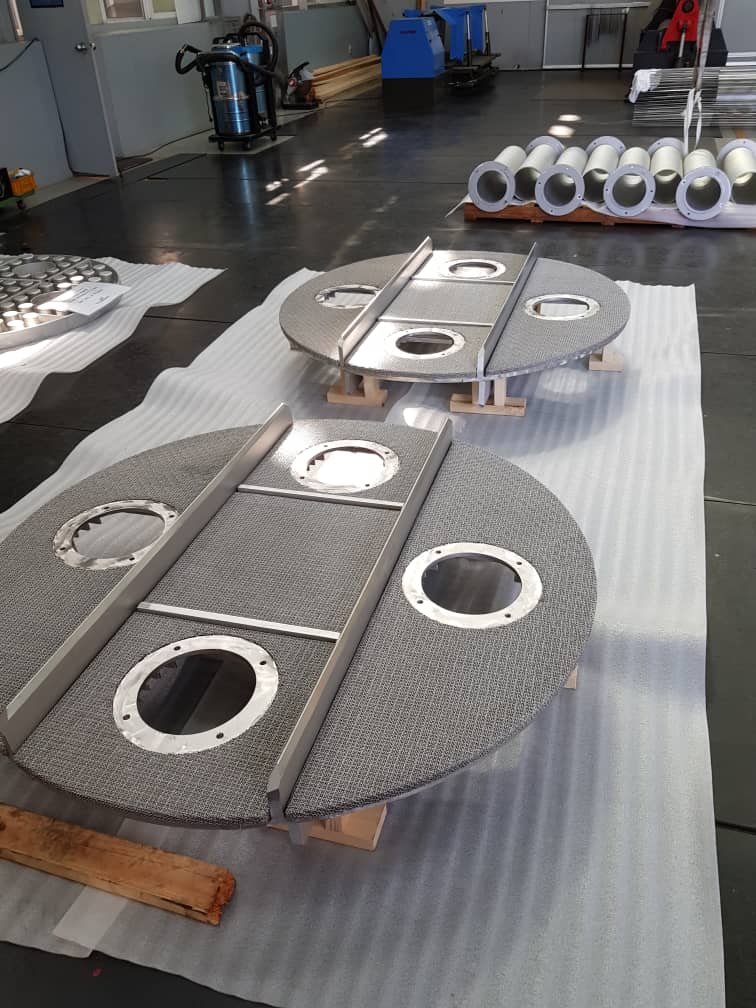
Demister tray sections with flanged vapour openings, laid out before packing. The knitted mesh fills the space between the openings and takes the droplets out of the vapour rising through them. Sections are made to the column drawing.

Sieve tray panels with their outlet weirs, set out on the floor after fabrication. Panels bolt together inside the column on the support ring. Perforations, weir heights and downcomer areas follow the customer’s process design.

Stainless steel riser pipes for a chimney tray, cut and prepared for welding into the tray deck. Each riser carries vapour up through the liquid layer on the tray. Pipes are cut square and chamfered so the welds to the deck are sound.

A perforated trough for a liquid distributor, before assembly into the distributor frame. Liquid drips from the holes in the trough onto the packed bed below. Hole size and spacing set the number of drip points per square metre.

A large-diameter tray assembled on the shop floor from its panels, with the downcomer and support beams in place. Assembling the tray before dispatch proves the fit and the levelling. The tray goes into a refinery column.

A section of a trough liquid distributor in stainless steel, with the perforated floor and the end plates. Sections are joined inside the column to make up the full distributor. The troughs are levelled after installation so the liquid splits evenly.

Structured packing modules packed in a crate for delivery, each module cut to the column diameter. The modules go into the column in layers through the manway. The packing is made from corrugated stainless steel sheet.

A pipe-type liquid distributor with flanged connections installed above the packing in a refinery column, during a turnaround. The team fitted the packing, the distributor and the hold-down grid through the manway. The photo was taken during a 2023 turnaround in Malaysia.

A worn valve tray deck removed from a biodiesel column, with the valves corroded and the deck thinned. Trays like this are measured and replaced with new decks to the original design. Peltech makes replacement trays for existing columns.

Bulk bags of metal random packing ready for delivery to a column job. Random packing is poured into the column onto the support grid and levelled. The packing size and material are chosen for the service.

A flanged nozzle set into a vessel shell, with the weld ground and ready for dye penetrant testing. The nozzle is welded from both sides where access allows. Welding is done to ASME IX procedures by qualified welders.

Close-up of a flange-to-shell weld with the heat tint still on, before pickling. The weld profile is inspected visually and by dye penetrant before the tint is removed. Pickling restores the corrosion resistance of the stainless steel.

A large fabricated basket strainer with its test gauge in place. Every body is hydrostatically tested before dispatch, and the test record goes with the delivery documents.

An old filter vessel as it arrived for refurbishment, with corroded nozzles and damaged paint. The vessel was stripped, inspected, repaired and repainted before going back into service. Refurbishment extends the life of a vessel at a fraction of the cost of a new one.

New swing bolts and their pins primed before fitting to a refurbished vessel head. Swing bolts are replaced as a set so the closure loads evenly. The bolts are made to suit the existing lugs.

A new support bracket welded to a refurbished vessel and primed, with the surrounding paint masked off. Supports are replaced where the old ones are corroded or where the vessel moves to a new position. The weld was inspected before painting.

A shell course rolled from stainless steel plate, with the longitudinal seam still open before welding. The course is checked for roundness and the seam edges prepared for the weld. Rolling is done in-house on the plate rolls.

The hydraulic shear in the Senai workshop, used to cut plate and sheet to size for frames, trays and shells. Cutting in-house keeps lead times short. Plate is cut, rolled and welded under one roof.

The press brake in the workshop, used to fold sheet for frames, channels and tray parts. Folding gives clean straight edges on leaf frames and tray panels. The machine takes sheet up to the thickness used on the heavier vessels.

A nozzle weld on a strainer body after dye penetrant testing, with the white developer applied. Any crack or porosity shows as a red mark in the developer. The test is done on nozzle and flange welds before pickling or painting.

A temporary cone strainer measured with a tape against the drawing before packing. The flange diameter and the cone length are checked on every piece. The dimensions are recorded on the inspection sheet.

Large demister sections crated and wrapped outside the works for shipment. Crates are built to the section size and lined so the mesh is not pressed in transit. Each crate is marked with its section number.

A lorry loaded with crated demister sections leaving the works. Crates are strapped and sheeted for the road. Deliveries go to plants across Malaysia, Singapore and Indonesia.